New Homeowner HVAC Guide: The Smart Checklist for First-Time Homeowners in Austin
Everything you need to check before buying, right after moving in, and throughout your first year in Austin — so you can avoid costly surprises and enjoy cleaner, more comfortable indoor air from day one.
Summer scheduling fills fast in Austin. Book your new-home duct inspection now before peak season demand hits — spots are limited through August.
What Should You Inspect on the HVAC System Before Buying a House?
Before you close on any property in Austin, you should gather specific information about the HVAC system. Start by identifying the age and type of equipment. Is it a central air conditioner paired with a gas furnace, a heat pump, or a package unit? The age matters because it sets expectations for remaining lifespan and potential repair costs. Next, check the condition of both the indoor and outdoor units. Look for visible corrosion, oil stains near refrigerant lines, water damage around the air handler, and excessive dirt on the condenser coils outside.
Ask the seller or listing agent for maintenance records, repair invoices, and warranty documentation. A system with a well-documented service history is far more reassuring than one with no records at all. During your walkthrough, turn the system on in both heating and cooling modes if possible. Listen for unusual noises such as banging, grinding, or high-pitched squealing. Walk through every room and check whether airflow feels consistent from room to room. Temperature differences between rooms can signal duct problems, equipment issues, or poor insulation.
Why a General Home Inspection Is Not Enough for HVAC
Many first-time buyers assume that the standard home inspection covers everything they need to know about the HVAC system. In reality, a general home inspection is limited in scope. According to the American Society of Home Inspectors, inspections provide information about the condition of systems at the time of inspection based on readily accessible, visually observable components only. That means the inspector verifies whether the unit turns on and produces hot or cold air, but does not measure actual cooling capacity, airflow balance between rooms, internal duct cleanliness, or the remaining life expectancy of critical components like the heat exchanger or compressor.
If the home you are buying has a system that is more than ten years old, or if the general inspection report leaves you with unanswered questions, consider scheduling a dedicated HVAC evaluation. A specialized technician can test system performance under load, check refrigerant levels, measure temperature differentials, and identify wear that a visual-only inspection simply cannot detect. This additional step can save you thousands of dollars in unexpected repairs during your first year.
A Common Mistake: Skipping the Duct Assessment Entirely
One of the most overlooked areas during a home purchase is the ductwork itself. Buyers focus on the furnace, the air conditioner, and the thermostat, but the network of ducts connecting those components to every room in the house often goes unexamined. Leaky, disconnected, or heavily contaminated ducts can reduce system efficiency, create uneven temperatures, and circulate dust, debris, and allergens throughout the home.
In Austin, where air conditioning runs for a large part of the year, duct performance has a direct impact on both comfort and energy costs. If the previous owner completed renovations, had pets, or neglected maintenance for an extended period, the interior of those ducts may contain construction debris, pet dander, dust buildup, or other contaminants. Addressing duct condition early — before you settle in — gives you a much cleaner baseline for indoor air quality moving forward.
Your Move-In Day HVAC Checklist: What to Do in the First 48 Hours
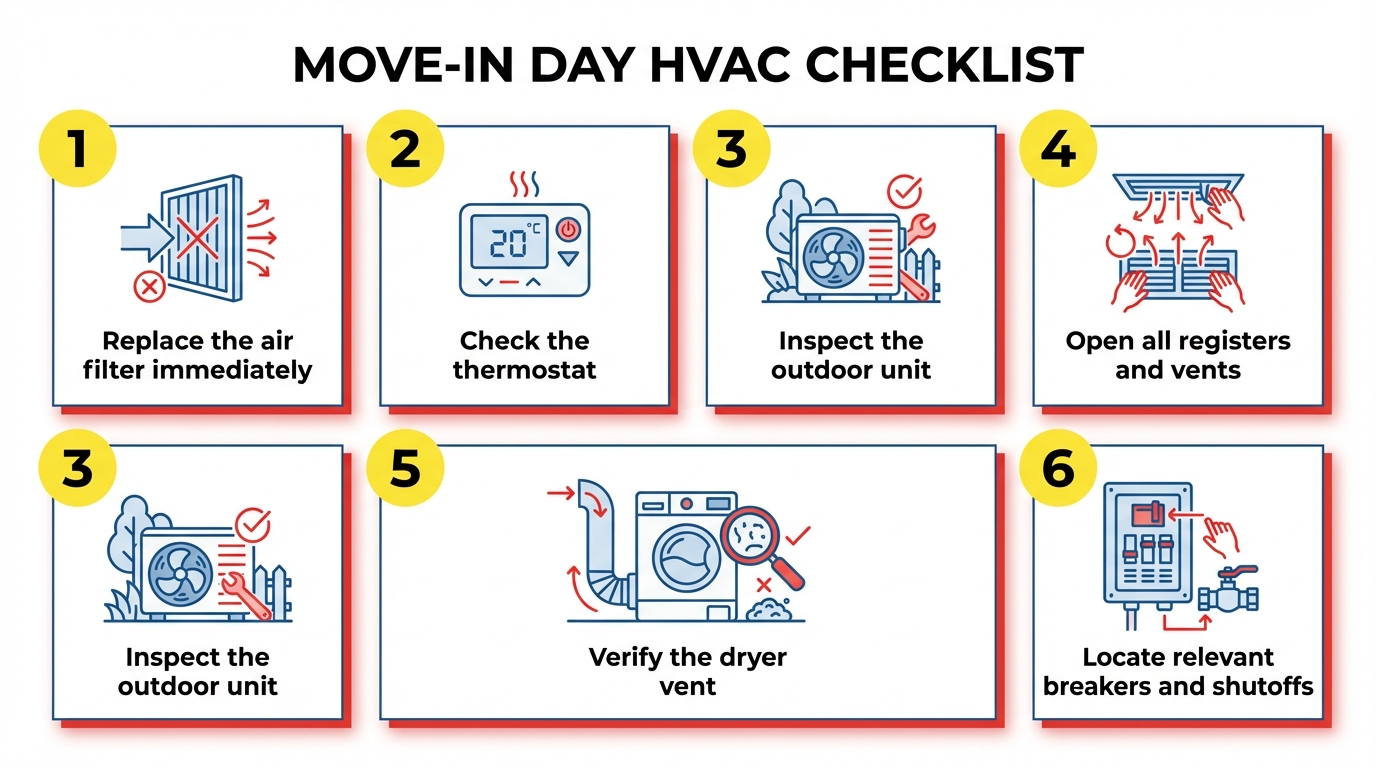
The first two days in your new Austin home are the ideal time to establish a few HVAC basics. These steps are simple, inexpensive, and can prevent avoidable problems right from the start.
Replace the air filter immediately. You do not know when the previous owner last changed it, and a clogged filter restricts airflow and forces the system to work harder. According to the U.S. Department of Energy, replacing or cleaning filters regularly is critical because dirty filters reduce airflow and system efficiency.
Check the thermostat. Make sure it powers on, responds to temperature adjustments, and is set to a reasonable schedule. If the home has a programmable or smart thermostat, take a few minutes to learn its settings. Proper thermostat scheduling is one of the simplest ways to reduce energy waste.
Inspect the outdoor unit. Walk around the condenser and clear away any weeds, leaves, trash, or debris within at least two feet of the unit. Restricted airflow around the condenser reduces cooling performance, especially during Austin summers.
Open all registers and vents. Walk through every room and ensure that supply and return vents are open and unblocked by furniture, rugs, or curtains. Blocked registers disrupt airflow balance and can cause pressure problems within the duct system.
Verify the dryer vent. While you are checking the HVAC system, take a moment to inspect the dryer vent as well. Lint buildup in dryer vents is a fire safety concern that many new homeowners overlook. If you notice poor dryer performance or cannot confirm when the vent was last cleaned, scheduling professional dryer vent cleaning is a practical safety step.
Locate relevant breakers and shutoffs. Identify the circuit breakers for your HVAC system and the gas shutoff valve if applicable. Knowing where these are in advance saves time during any future emergency or service appointment.
Just Moved Into Your Austin Home?
Start with a professional duct inspection. Know exactly what is inside your system before you unpack the last box.
Is Air Duct Cleaning Actually Worth It When You Move In?
This is one of the most common questions new homeowners ask, and the honest answer is: it depends on the condition of the home. Air duct cleaning is not something that needs to happen on a fixed monthly or annual schedule. However, there are specific scenarios where it makes clear, practical sense — especially during a move-in.
The U.S. Environmental Protection Agency recommends considering duct cleaning when there is visible mold growth inside ducts or on other HVAC components, evidence of rodent or insect infestation, or substantial visible debris being released into the home from supply registers. If the previous owner completed a major renovation, construction dust and drywall particles may be sitting inside the ductwork, waiting to circulate through your home the moment you turn the system on.
For Austin homeowners moving into a home with an unknown maintenance history, a professional duct inspection is a reasonable first step. A qualified technician can look inside the ducts, assess the level of buildup, and recommend cleaning only if it is genuinely warranted. Nonstop Air Duct Cleaning Austin approaches this with a practical, no-pressure evaluation. The team inspects the system, explains what they find, and lets you make an informed decision rather than pushing unnecessary service.
Red Flags That Suggest Your Ducts Need Attention
| Warning Sign | What It May Indicate | Recommended Action |
|---|---|---|
| Visible dust or debris around vent covers | Buildup inside the duct system | Professional inspection and possible cleaning |
| Musty or stale odor when the system runs | Mold, mildew, or organic matter in ducts | Inspection, cleaning, and moisture source investigation |
| Evidence of rodent droppings or nesting | Pest contamination inside ductwork | Pest remediation followed by duct cleaning and sanitizing |
| Excessive dust accumulation shortly after cleaning | Contaminants recirculating through ducts | Duct inspection to identify source of debris |
| Recent construction or renovation by previous owner | Drywall dust, sawdust, or insulation particles in ducts | Post-construction duct cleaning |
How Airflow Problems Reveal Hidden Duct Issues
If you notice that some rooms in your new Austin home are noticeably warmer or cooler than others, the problem may not be the HVAC equipment itself. Uneven temperatures are one of the most common indicators of duct-related issues such as leaks at connections, collapsed flexible duct runs, or improperly sized ductwork. When conditioned air escapes through gaps before reaching its intended destination, certain rooms receive less airflow while the system works harder to compensate.
A practical test during your first week is to hold a tissue near each supply vent while the system is running. Vents with noticeably weaker airflow compared to others may indicate a restriction, disconnect, or leak in the duct run serving that area. While this simple check does not replace a professional diagnosis, it gives you useful information to share with a technician if you decide to schedule an inspection.
Setting Up Your First-Year Maintenance Schedule
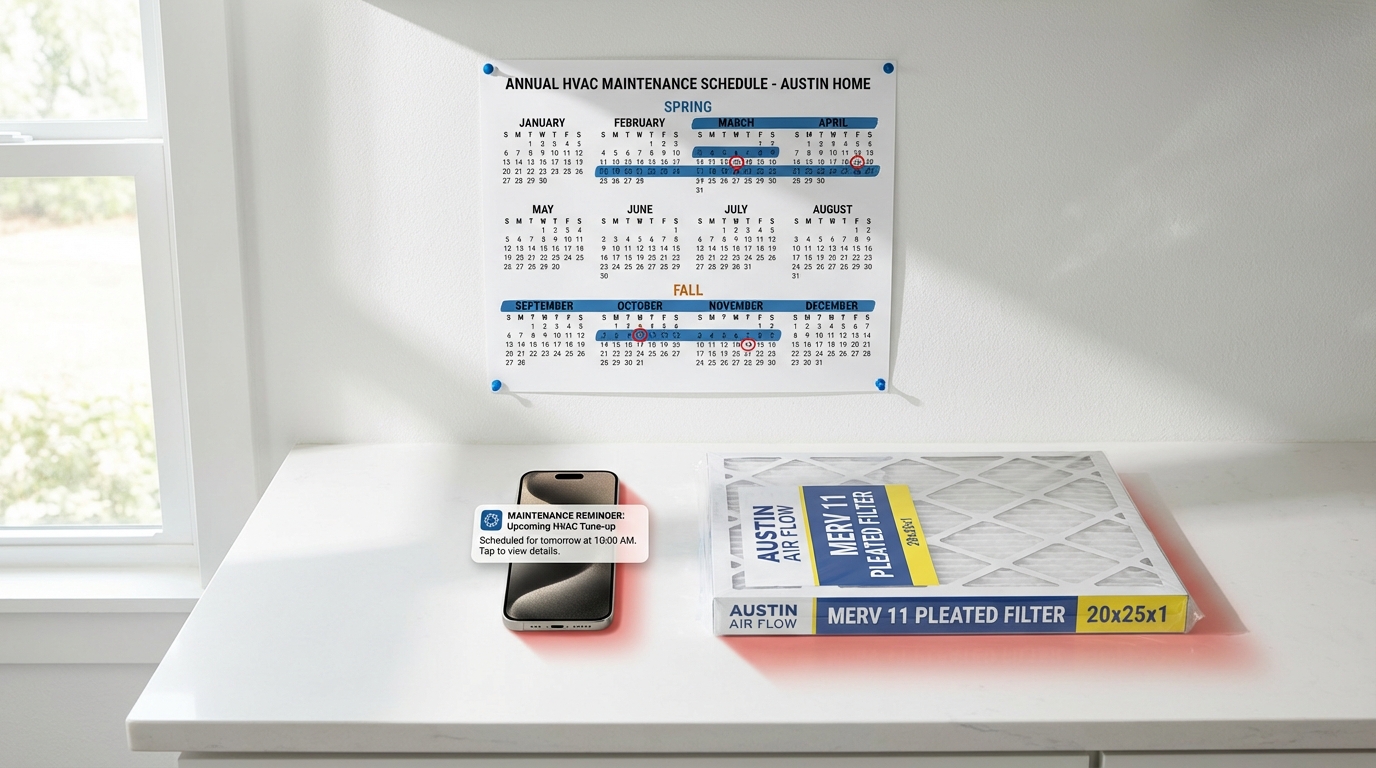
Once you have settled in and completed your move-in checklist, the next priority is establishing a recurring maintenance routine. For most Austin homeowners, the recommended approach is bi-annual professional service: schedule a cooling system checkup in the spring before summer heat arrives, and a heating system checkup in the fall before cooler weather sets in. The ENERGY STAR maintenance checklist recommends this pre-season approach to catch wear, verify performance, and address minor issues before they become expensive repairs.
If your home uses a gas furnace or any combustion-based heating equipment, annual safety inspections are especially important. The U.S. Consumer Product Safety Commission emphasizes the need to inspect furnace systems for carbon monoxide hazards, cracked heat exchangers, and proper venting. This is not optional maintenance — it is a safety measure that protects your family.
Budgeting for HVAC Costs in Your First Year and Beyond
One of the biggest financial mistakes new homeowners make is calculating only the mortgage and moving costs without setting aside a buffer for home system maintenance and repairs. Your HVAC system is one of the most expensive components in the house, and planning ahead financially can prevent stressful surprises.
| Expense Category | When It Typically Applies | Key Benefit | Key Limitation |
|---|---|---|---|
| Preventive maintenance (bi-annual tune-ups) | Ongoing, every spring and fall | Extends equipment life, reduces breakdowns | Does not fix advanced wear or aging components |
| Spot repair (single component failure) | When a specific part fails | Lower immediate cost than full replacement | May recur if the overall system is aging |
| Full system replacement | System is old, inefficient, or failing repeatedly | Long-term efficiency, comfort, and reliability | Significant upfront investment |
Modern heat pump and air conditioning systems are generally designed for a lifespan in the range of 15 years, though actual longevity depends on usage, climate, and maintenance quality. If the system in your new home is already approaching that age, start building a replacement fund now rather than waiting for an emergency failure during an Austin summer.
Ready to Breathe Easier?
Get an honest assessment of your ductwork and HVAC system. No pressure, no upsells — just clear answers from Austin’s trusted air duct professionals.
What Maintenance Can You Safely Handle Yourself?
Not every HVAC task requires a professional visit. As a new homeowner, you can handle several basic but impactful maintenance steps on your own. Replacing the air filter every one to three months is the single most effective DIY task. Keeping the area around supply and return vents clear of obstructions maintains proper airflow. Periodically rinsing dirt and debris off the outdoor condenser with a garden hose improves heat exchange efficiency. Checking thermostat batteries and verifying that scheduled programming is still correct takes only a few minutes.
However, there are clear boundaries to safe DIY work. Do not attempt to handle refrigerant, open electrical panels, disassemble internal components, or diagnose complex mechanical failures on your own. These tasks require trained technicians with the right tools and safety knowledge. When in doubt, calling a professional is always the more practical and safer choice.
How Do You Know If the HVAC System Is Too Old to Keep?
Age alone does not automatically mean the system needs to go, but it is a critical factor in the overall equation. A system that is well-maintained and performing efficiently may still have years of useful life left, even if it is approaching 12 or 13 years old. On the other hand, a system that is only eight years old but has been neglected, repaired multiple times, or is struggling to maintain consistent temperatures may be a better candidate for replacement than continued patching.
The practical decision framework comes down to three questions. First, how frequently is the system requiring repairs, and are those repair costs adding up? Second, are your energy bills significantly higher than comparable homes in your Austin neighborhood? Third, is the system keeping your home comfortable during peak summer and winter conditions? If two or more of these answers point to problems, it is worth getting a professional assessment to compare repair costs against replacement value.
Warning Signs Every New Austin Homeowner Should Watch For
During your first month in the home, pay close attention to how the system behaves under normal use. You are establishing your personal baseline, and early detection of problems saves both money and inconvenience. Watch for temperature inconsistencies between rooms, which may indicate duct leaks or airflow imbalances. Listen for unusual sounds such as clicking, banging, or a high-pitched whine, which can signal mechanical wear or loose components.
A burning smell when the system first starts after a long period of inactivity is sometimes normal as dust burns off, but a persistent burning odor is a red flag. Musty or moldy smells coming from the vents suggest moisture issues inside the duct system. Short cycling — where the system turns on and off rapidly without completing a full heating or cooling cycle — often points to an oversized unit, a failing component, or a thermostat problem. If you notice water pooling near the indoor unit or visible condensation on ductwork, moisture management needs immediate attention.
Making Your HVAC System More Efficient After Moving In
Efficiency improvements do not always require expensive upgrades. Start with the fundamentals: a clean filter, unobstructed vents, a properly programmed thermostat, and a clean outdoor unit. These four basics alone can meaningfully reduce energy waste. Beyond that, consider having a professional check for duct leaks. According to the Department of Energy, leaky ducts can reduce system efficiency significantly by allowing conditioned air to escape into unconditioned spaces like attics and crawlspaces.
Sealing duct connections and adding insulation to duct runs in unconditioned areas are two of the most cost-effective improvements available. If your home has older single-pane windows or insufficient attic insulation, addressing those issues also reduces the workload on your HVAC system. Nonstop Air Duct Cleaning Austin offers duct sealing and insulation services that help Austin homeowners reduce energy waste without replacing the entire system — a practical option for buyers who want to improve performance without a major capital outlay.
Comparing Scenarios: When to Clean, Repair, or Replace
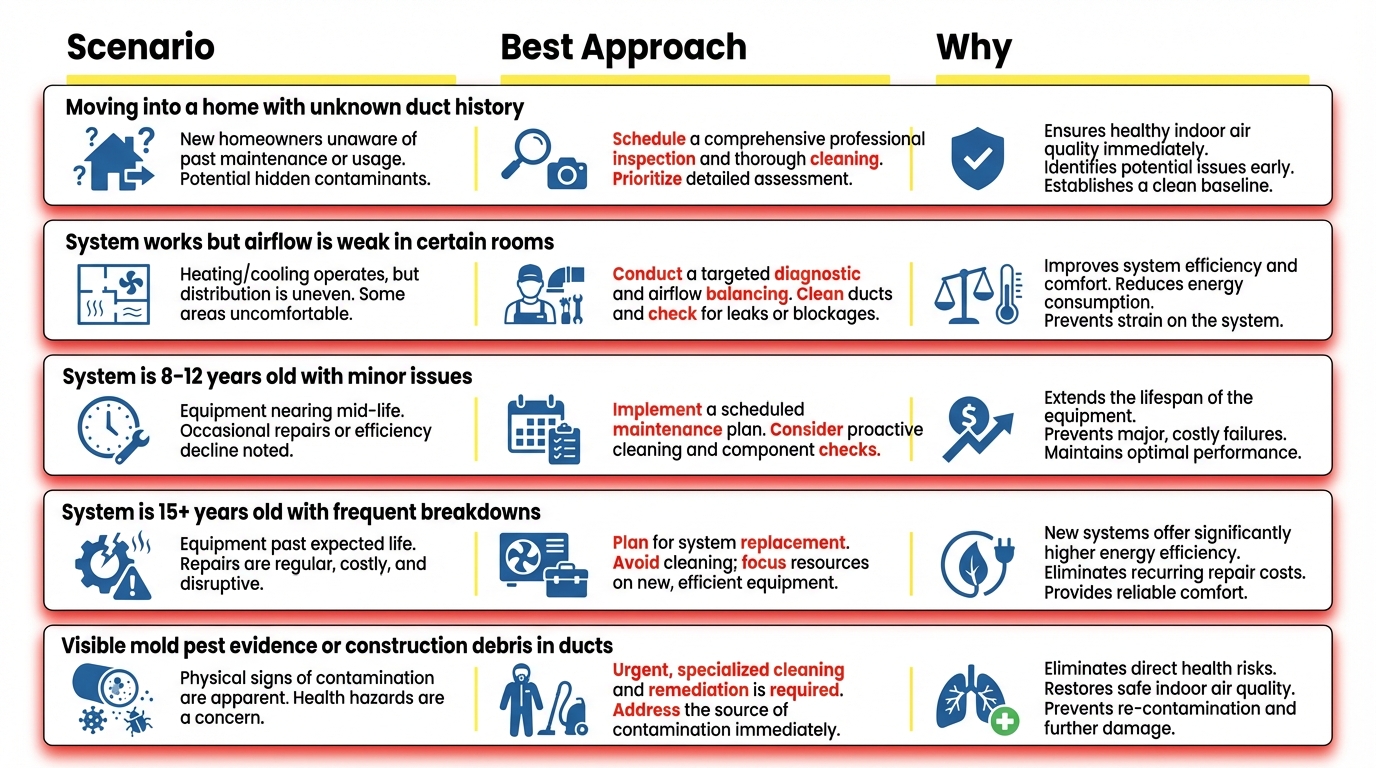
| Scenario | Best Approach | Why |
|---|---|---|
| Moving into a home with unknown duct history | Professional duct inspection, possible cleaning | Establishes a clean baseline for indoor air quality |
| System works but airflow is weak in certain rooms | Duct inspection and possible sealing or repair | Restores proper airflow without replacing equipment |
| System is 8–12 years old with minor issues | Professional tune-up and targeted repairs | Extends useful life at a lower cost than replacement |
| System is 15+ years old with frequent breakdowns | Replacement evaluation | Ongoing repair costs may exceed the value of a new system |
| Visible mold, pest evidence, or construction debris in ducts | Duct cleaning and sanitizing | Addresses contamination that affects air quality and health |
What MERV Rating Filter Should a New Homeowner Use?
Filter selection is more nuanced than many homeowners realize. MERV ratings indicate how effectively a filter captures particles of different sizes. A higher MERV number means finer filtration, which sounds like a clear win. However, higher-rated filters also create more airflow resistance. According to ASHRAE, many residential systems can handle MERV 13 filtration with little or no performance impact, but some older or smaller systems may not be designed for that level of resistance.
For most new homeowners in Austin, a MERV 8 to MERV 11 filter is a safe and effective starting point. If you have allergies, pets, or specific air quality concerns, upgrading to MERV 13 is reasonable, but confirm with a technician that your system can handle the increased resistance without reducing airflow. The worst outcome is installing a premium filter that starves the system of air and causes it to work harder, wear faster, and deliver less comfort.
Start Your First Year as a Homeowner with Confidence
Whether you need a duct inspection, a thorough cleaning after a renovation, or an honest opinion on your system’s condition — Nonstop Air Duct Cleaning Austin is here to help.
Frequently Asked Questions
For most Austin homes, every one to three months is the standard recommendation. If you have pets, allergies, or live near construction activity, lean toward monthly replacement. Check the filter visually each month. If it looks gray and clogged, replace it regardless of how recently you installed it.
Annual duct cleaning is generally not necessary for most homes. The EPA recommends cleaning when there is a specific reason such as visible mold, pest contamination, or heavy debris. A better approach is to have ducts inspected periodically and cleaned only when conditions warrant it.
Yes, in most cases it is safe to operate the system normally while waiting for a scheduled inspection. If you notice a burning smell that does not dissipate after a few minutes, hear loud or unusual noises, or see water leaking near the unit, turn the system off and contact a professional promptly.
Request the age and brand of the equipment, any available maintenance records, dates of recent repairs or part replacements, warranty information, and the name of any service company that previously maintained the system. This history helps your own technician assess the system more accurately.
Common signs include rooms that are hard to heat or cool, higher-than-expected energy bills, visible dust streaks around vent connections, and audible whistling or hissing sounds near duct joints. A professional duct leakage test provides a definitive answer and identifies exactly where sealing is needed.
A smart thermostat can help optimize energy use by learning your schedule and adjusting temperatures automatically. For Austin homeowners dealing with high cooling costs in summer, the energy savings from better scheduling often justify the investment within the first year. However, the benefit depends on consistent use and proper setup.
Call a professional if the system stops heating or cooling entirely, if you smell gas or a persistent burning odor, if the unit is making grinding or banging noises, if you notice refrigerant leaks or ice forming on the equipment, or if your energy bills spike without an obvious explanation. Attempting to diagnose electrical, refrigerant, or combustion issues without training is unsafe.

About Nonstop Air Duct Cleaning Austin
Nonstop Air Duct Cleaning Austin is a locally owned and operated indoor air quality company serving Austin, TX and surrounding areas throughout Travis, Williamson, and Hays counties. We specialize in residential and commercial air duct cleaning, dryer vent cleaning, chimney sweeping, and HVAC maintenance services. Our team is committed to providing transparent pricing, professional workmanship, and honest recommendations based on the actual condition of your system — not a one-size-fits-all sales approach.