If your Austin home always seems dusty no matter how often you clean, or you notice stale odors lingering near the vents, there is a good chance the air moving through your living space carries more than you realize. Dust, pet dander, pollen, volatile organic compounds, and even traces of smoke can circulate through your HVAC system and settle into every room. According to the EPA, indoor air can contain higher concentrations of certain pollutants than outdoor air, making home air purification solutions a practical priority for many homeowners. This guide walks you through the different types of indoor air cleaning solutions available, explains how they work, helps you compare whole-home systems with portable units, and shows you what to look for so you can choose a solution that actually fits your home and your budget.
Estimated reading time: 15 minutes
Key Takeaways
- Home air purification solutions range from portable HEPA units for single rooms to whole-home systems integrated into your HVAC ductwork.
- Air filtration captures particles like dust and pollen, while air purification can also target gases, odors, and biological contaminants using technologies such as activated carbon and UV light.
- Proper sizing and matching the purification technology to your specific indoor air concern are essential for effective results.
- Clean ductwork is the foundation for any purification upgrade; a dirty duct system reduces the effectiveness of even the best air purifier.
- Regular filter replacement and professional HVAC maintenance keep your air purification system performing at its best over time.
- Austin homeowners face year-round air quality challenges including cedar pollen, wildfire smoke, persistent dust, and humidity-related concerns.
- What Are Home Air Purification Solutions and Why Do Austin Homeowners Need Them?
- What Is a Whole Home Air Purifier?
- A Scenario Many Austin Homeowners Recognize
- What Is the Difference Between Air Filtration and Air Purification?
- Comparing Portable Units and Whole-Home Systems
- How Does an Air Purification System Protect Your Family?
- Five Common Mistakes Homeowners Make When Choosing Air Purification
- What Indoor Air Cleaning Solutions Help With Dust?
- Can an Air Purification System Help With Allergies?
- Can Air Purifiers Help With Smoke and Odors?
- Do Air Purifiers Help With Mold Spores?
- What Size Air Purifier Does Your Home Actually Need?
- How Often Should an Air Purification System Be Maintained?
- Combating Dust, Pollen, and Mold in Central Texas
- Is a Whole Home System Better Than a Portable Unit for Austin Homes?
- How Do You Choose the Right Home Air Purification Solution?
- Maximizing Your Home Air Purification Solutions
- What Is the Next Step for Your Austin Home?
- What Our Customers Say
- Find Us
- Frequently Asked Questions
What Are Home Air Purification Solutions and Why Do Austin Homeowners Need Them?
Home air purification solutions refer to the full range of devices and systems designed to reduce airborne contaminants inside your home. That includes standalone portable purifiers, in-duct filtration systems, ultraviolet germicidal devices, and activated-carbon filters that target gases and odors. The reason Austin homeowners increasingly explore these options is straightforward: Central Texas brings seasonal pollen surges, wildfire smoke events, persistent dust, and humidity that can encourage biological growth inside ductwork. Standard furnace filters alone may not address the full spectrum of particles and irritants present in the air you breathe every day.
Air purification works most effectively when the ductwork delivering air throughout your home is already clean and free of debris. That is why many homeowners pair purification upgrades with professional air duct cleaning to ensure the system starts from a clean baseline. Removing accumulated dust and buildup from inside the ducts means the purification system handles only fresh contaminants rather than fighting a backlog of particles that have been collecting for years.
What Is a Whole Home Air Purifier?
A whole home air purifier is a device or series of devices installed directly into your existing HVAC system. Instead of cleaning air in a single room, it treats every cubic foot of air that passes through your ductwork, reaching every room served by the central system. The U.S. Department of Energy explains that whole-house ventilation systems can filter incoming air to remove dust and pollen, making them a practical option for homes where consistent air quality matters throughout the entire living space.
How It Connects to Your Home Airflow
When your HVAC system pulls return air from your rooms, that air passes through the purification unit before being heated or cooled and pushed back out through supply vents. This means every cycle of air gets treated. Homes with well-sealed ductwork and properly sized systems benefit the most because less conditioned air escapes before reaching occupied rooms. If ducts have leaks or gaps, some untreated air can bypass the purifier entirely, which is one reason professional air duct video inspection matters.
A Scenario Many Austin Homeowners Recognize
Imagine moving into a home that feels comfortable at first, but after a few weeks you notice dust accumulating faster than expected, a faint musty smell near certain vents, and a family member sneezing more frequently indoors. You replace the furnace filter, vacuum regularly, and keep windows closed during high-pollen days, yet the problems persist. This is exactly the situation where evaluating home air purification solutions becomes a practical next step rather than a luxury. The issue is not cleanliness; it is what your standard filter cannot catch.
The EPA states that indoor air can be two to five times more polluted than outdoor air. In Austin, where homes are sealed tightly against summer heat, contaminants can accumulate quickly without proper filtration and ventilation.
Ready to improve your indoor air quality? Contact Nonstop Air Duct Cleaning Austin today for a professional duct assessment.
What Is the Difference Between Air Filtration and Air Purification?
These two terms are often used interchangeably, but they describe different approaches. Understanding the distinction helps you make a more informed decision about what your home actually needs.
Air Filtration for Dust, Pollen, and Particles
Filtration relies on physical media, such as fiberglass, pleated fabric, or HEPA-rated material, to capture solid particles as air passes through. Higher-rated filters trap smaller particles. A MERV 13 filter, for instance, can capture a significant portion of fine particles including some bacteria and certain allergens. The EPA notes that central forced-air systems should ideally use at least MERV 13 filtration for added protection.
Air Purification for Broader Indoor Air Concerns
Purification can include filtration but also encompasses technologies that target gases, volatile organic compounds, odors, and biological contaminants. Activated-carbon media absorbs chemical vapors, while ultraviolet germicidal systems can neutralize certain biological organisms passing through the airstream. A true air purification system may combine multiple technologies to address a wider range of indoor air quality concerns than a standalone filter can handle on its own. Homeowners interested in UV-based solutions can explore UV light installation as a complementary option.
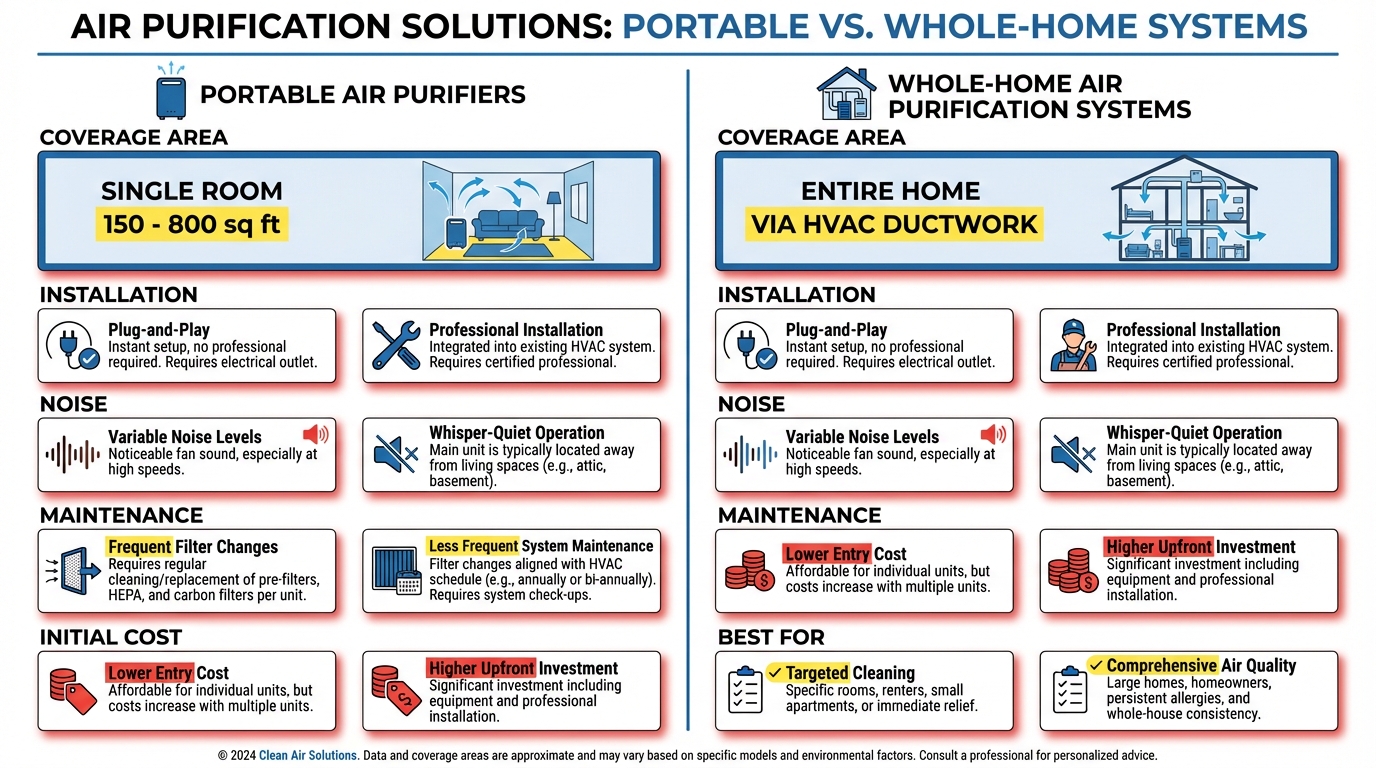
Comparing Portable Units and Whole-Home Systems
| Factor | Portable Air Purifier | Whole Home Air Purifier |
|---|---|---|
| Coverage area | Single room, typically 150-800 sq ft | Entire home via HVAC ductwork |
| Installation | Plug-in, no professional setup needed | Requires professional integration with HVAC |
| Noise | Varies by unit, audible in the room | Operates within existing HVAC system, less noticeable |
| Maintenance | Filter replacement every few months | Filter or component checks on a regular schedule |
| Initial cost | Lower upfront | Higher upfront, but covers entire home |
| Best for | Targeted relief in one room, renters, temporary needs | Whole-home coverage, families with allergies, long-term use |
If you only need cleaner air in a bedroom or home office, a portable unit can be a practical and affordable choice. However, if you want consistent air quality in every room, especially in a larger Austin home with multiple bedrooms and living areas, a whole home air purifier integrated into your HVAC system usually delivers more reliable results over time.
How Does an Air Purification System Protect Your Family?
An air purification system works by repeatedly cycling the air in your home through one or more cleaning stages. Each pass through the system reduces the concentration of airborne contaminants. The EPA explains that air cleaners remove contaminants from the air that flows through them, but they are less effective for pollutants already settled on surfaces. That is why purification works best as part of a broader routine that includes regular cleaning, dust management, and professional HVAC system cleaning.
HEPA Filtration and CADR Ratings Explained
HEPA stands for High-Efficiency Particulate Air. A true HEPA filter captures at least 99.97 percent of particles that are 0.3 microns in diameter. CADR, or Clean Air Delivery Rate, measures how quickly a purifier can clean the air in a given space. A higher CADR means faster particle removal. When evaluating home air purification solutions, checking both the HEPA certification and the CADR rating helps you understand whether a unit can actually handle the size and contaminant load of your living area.
Five Common Mistakes Homeowners Make When Choosing Air Purification
Buying based on price alone. The least expensive unit may not have the filtration grade or airflow capacity your home requires. An undersized purifier running in a large room is essentially decorative.
Ignoring the ductwork. Installing a whole-home purifier on a duct system full of accumulated dust and debris reduces effectiveness from day one. A clean system is the foundation for any purification upgrade.
Forgetting about filter replacement. Every air purification system requires regular maintenance. A clogged or expired filter restricts airflow, forces the HVAC to work harder, and defeats the purpose of the investment.
Assuming one solution handles everything. A HEPA filter is excellent for particles but will not address chemical vapors or persistent odors. Matching the technology to the specific problem is essential.
Skipping professional assessment. Every home has a different layout, duct configuration, and contaminant profile. What works in a newer single-story home may not be the right approach for an older two-story property with aging ductwork. A professional air duct troubleshooting service can identify issues before you invest.
Before purchasing any air purification system, have your ductwork inspected and cleaned. Removing years of accumulated dust and debris ensures your new purifier works against fresh contaminants rather than an existing backlog.
What Indoor Air Cleaning Solutions Help With Dust?
Dust is the most common complaint Austin homeowners have about their indoor air. It comes from outdoor particles tracked in, skin cells, fabric fibers, pet dander, and pollen that enters through doors and windows. Effective indoor air cleaning solutions for dust typically combine mechanical filtration with proper duct maintenance. A well-rated filter installed in a clean duct system captures a large proportion of dust particles before they reach your living space. However, if your ducts contain years of accumulated buildup, the system redistributes that debris every time the fan runs, which is why many homeowners see a noticeable improvement after professional air duct cleaning combined with a filter upgrade.
Can an Air Purification System Help With Allergies?
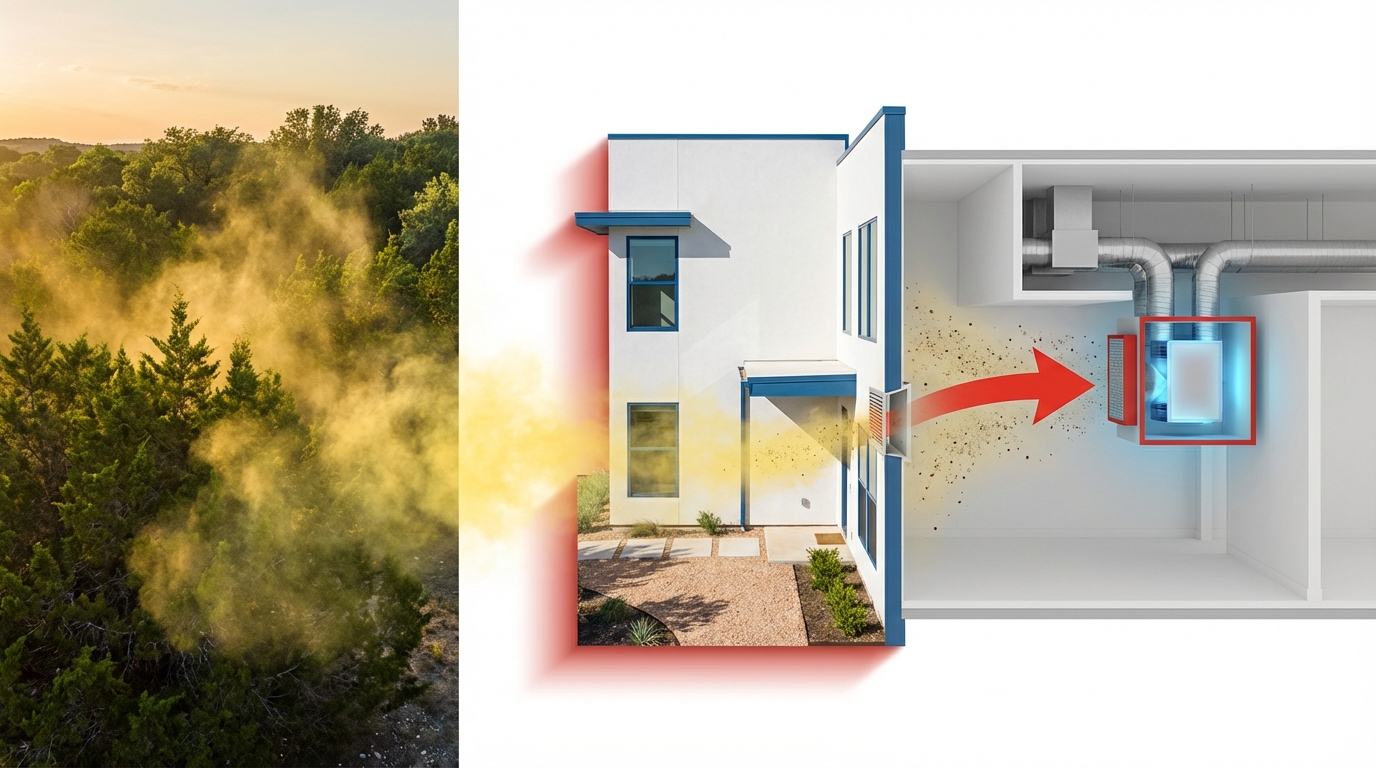
For Austin residents who deal with seasonal cedar fever, oak pollen, ragweed, or year-round sensitivities to dust mites and pet dander, an air purification system can meaningfully reduce the concentration of allergens in indoor air. The key is choosing the right filtration level. HEPA-grade systems capture the majority of common allergens, including pollen grains and dander particles that trigger respiratory discomfort. That said, purification alone does not eliminate allergies. It reduces exposure, which can make a noticeable difference in daily comfort, especially in bedrooms and common areas where people spend the most time.
Nonstop Air Duct Cleaning Austin helps homeowners take a practical first step by inspecting and cleaning the duct system so that purification technology works against fresh contaminants rather than existing buildup. This combination of clean ducts and effective purification tends to produce better results than either approach on its own.
Can Air Purifiers Help With Smoke and Odors?
Yes, but the type of purifier matters significantly. Smoke particles are extremely small, so a HEPA filter can capture many of them. However, the gaseous chemicals and odors associated with smoke, whether from cooking, tobacco, or wildfire events, often require activated-carbon or similar adsorptive media. The EPA notes that while air cleaners can reduce airborne particles, they may not fully address gases and odors without specialized filtration.
Austin occasionally experiences wildfire smoke events that affect outdoor and indoor air quality. During these periods, running a well-matched air purification system with both particle and gas-phase filtration can help keep indoor conditions more comfortable. Homeowners dealing with persistent odors in their ductwork may also benefit from professional air duct odor removal services.
Have questions about improving the air quality in your Austin home? Our team is here to help with honest guidance and professional service.
Do Air Purifiers Help With Mold Spores?
Air purifiers equipped with HEPA filters can capture mold spores circulating in the air. This reduces the number of spores you breathe in and can help with allergy-like symptoms. However, it is critical to understand that no air purifier solves a mold problem at its source. The CDC confirms that mold exposure is associated with allergies and respiratory symptoms, but the root cause is always moisture. If your home has a moisture issue, that must be addressed first through proper remediation, humidity control, and adequate ventilation.
For homeowners looking to reduce biological growth within the HVAC system itself, UV light installation inside the air handler can help neutralize certain organisms before they circulate through the ductwork. This is a complementary approach that works alongside filtration rather than replacing it. Professional air duct sanitizing can also address existing contamination within the duct system.
What Size Air Purifier Does Your Home Actually Need?
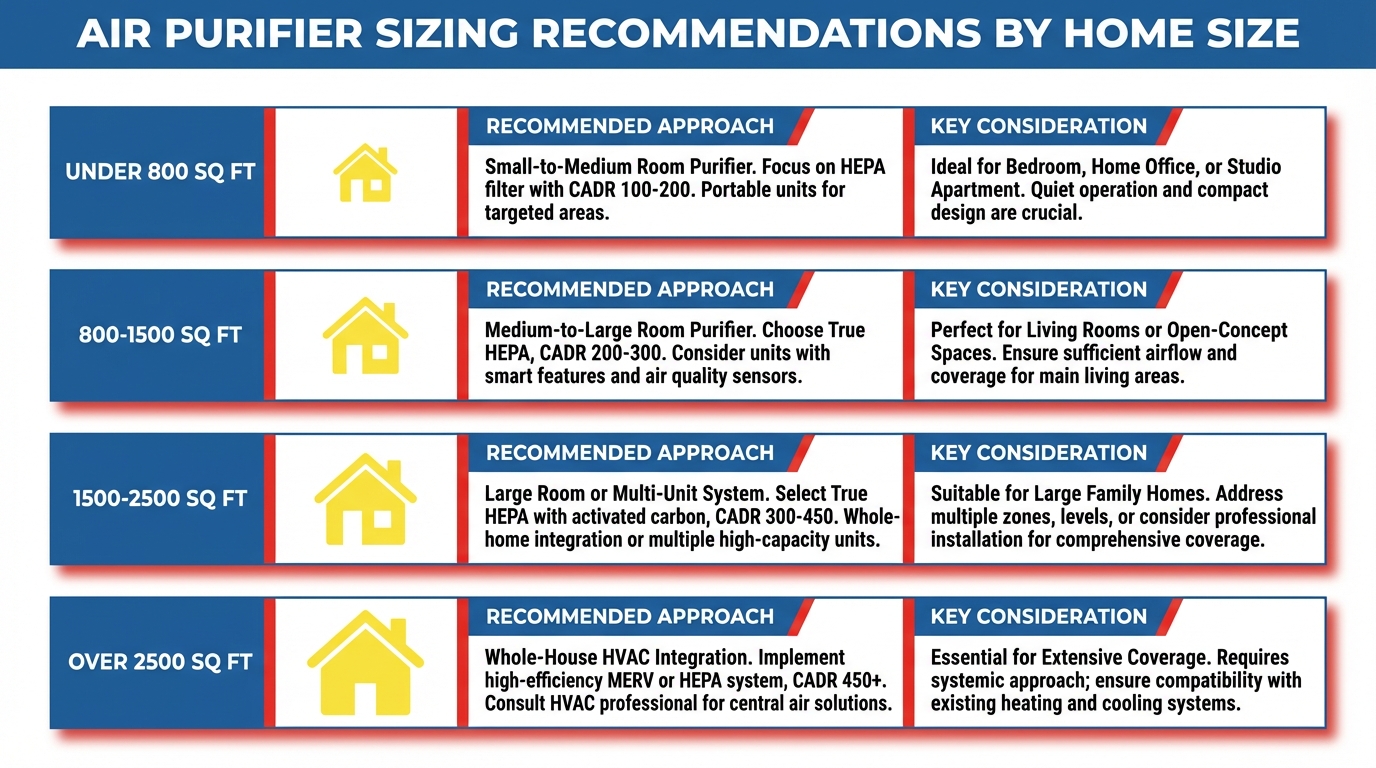
Sizing is one of the most overlooked factors in choosing home air purification solutions. A unit rated for 300 square feet will not deliver meaningful results in a 1,500-square-foot home. For portable purifiers, match the CADR rating to the room size where the unit will operate. For whole-home systems, the air purification capacity needs to align with the HVAC system’s airflow rate, which is measured in cubic feet per minute. An undersized purifier creates a bottleneck; an oversized one may restrict airflow and strain the blower motor.
| Home Size | Recommended Approach | Key Consideration |
|---|---|---|
| Under 800 sq ft | Quality portable unit or basic in-duct filter | Ensure CADR matches room volume |
| 800-1,500 sq ft | In-duct filtration system or portable units in key rooms | Check MERV rating compatibility with HVAC |
| 1,500-2,500 sq ft | Whole home air purifier integrated with HVAC | Professional sizing and installation recommended |
| Over 2,500 sq ft | Whole home system, possibly with supplemental portable units | Duct condition and airflow balance are critical |
Nonstop Air Duct Cleaning Austin evaluates duct condition, airflow patterns, and system capacity as part of their service, which gives homeowners practical data to make better decisions about purification upgrades. Having a professional assess your system before choosing a purifier prevents the common mistake of investing in equipment that does not match the home’s actual needs.
How Often Should an Air Purification System Be Maintained?
Maintenance schedules depend on the type of system, the filter grade, household conditions, and local air quality. As a general guideline, portable HEPA purifiers need filter replacement every six to twelve months. Activated-carbon filters may need replacement more frequently in homes with high odor or chemical exposure. Whole-home systems require periodic inspection to ensure filters are not clogged, UV bulbs are functioning if installed, and airflow is not restricted. Neglecting maintenance reduces system performance gradually, which means you may not notice the decline until dust and odor levels have already increased.
Scheduling routine HVAC and duct checkups through a professional service ensures that every component of your indoor air cleaning setup is performing as intended. Regular air duct maintenance is especially important in Austin, where seasonal pollen and dust loads can shorten filter life compared to regions with milder air quality challenges.
Set a calendar reminder to check your air purification filters every three months. In Austin, heavy pollen seasons in winter and spring can clog filters faster than the manufacturer’s general timeline suggests.
Combating Dust, Pollen, and Mold in Central Texas
Austin sits in a region known for intense cedar pollen in winter, oak pollen in spring, and ragweed in fall. Add persistent dust from construction activity and occasional wildfire smoke, and indoor air quality becomes a year-round concern rather than a seasonal one. Humidity levels in Central Texas also fluctuate enough to create conditions where moisture can accumulate in poorly ventilated areas, potentially supporting mold growth in attics, crawl spaces, and inside ductwork.
A comprehensive approach to indoor air quality in Austin homes typically involves three layers: source control, such as fixing moisture issues and reducing tracked-in contaminants; ventilation improvements to ensure adequate fresh air exchange; and air purification to capture what remains. Homeowners who combine clean ductwork with a properly maintained purification system tend to notice reduced dust on surfaces, fewer allergy symptoms, and a generally fresher indoor environment. For those concerned about overall indoor conditions, professional air quality testing can provide a clear baseline before making upgrades.
Is a Whole Home System Better Than a Portable Unit for Austin Homes?
The answer depends on your situation. For renters or homeowners who want relief in just one or two rooms, portable air purifiers offer a flexible and affordable solution. You can move them as needed, and they require no modification to the HVAC system. For homeowners who want consistent air quality across the entire house, particularly those with children, pets, or family members with respiratory sensitivities, a whole home air purifier typically provides better long-term value. It runs quietly within the existing HVAC system, requires less daily attention than managing multiple portable units, and treats every room served by the duct system.
One practical advantage Nonstop Air Duct Cleaning Austin offers is the ability to inspect and clean the duct system before or alongside a purification upgrade. This means homeowners get a cleaner starting point, which helps any purification technology perform closer to its rated capacity from day one.
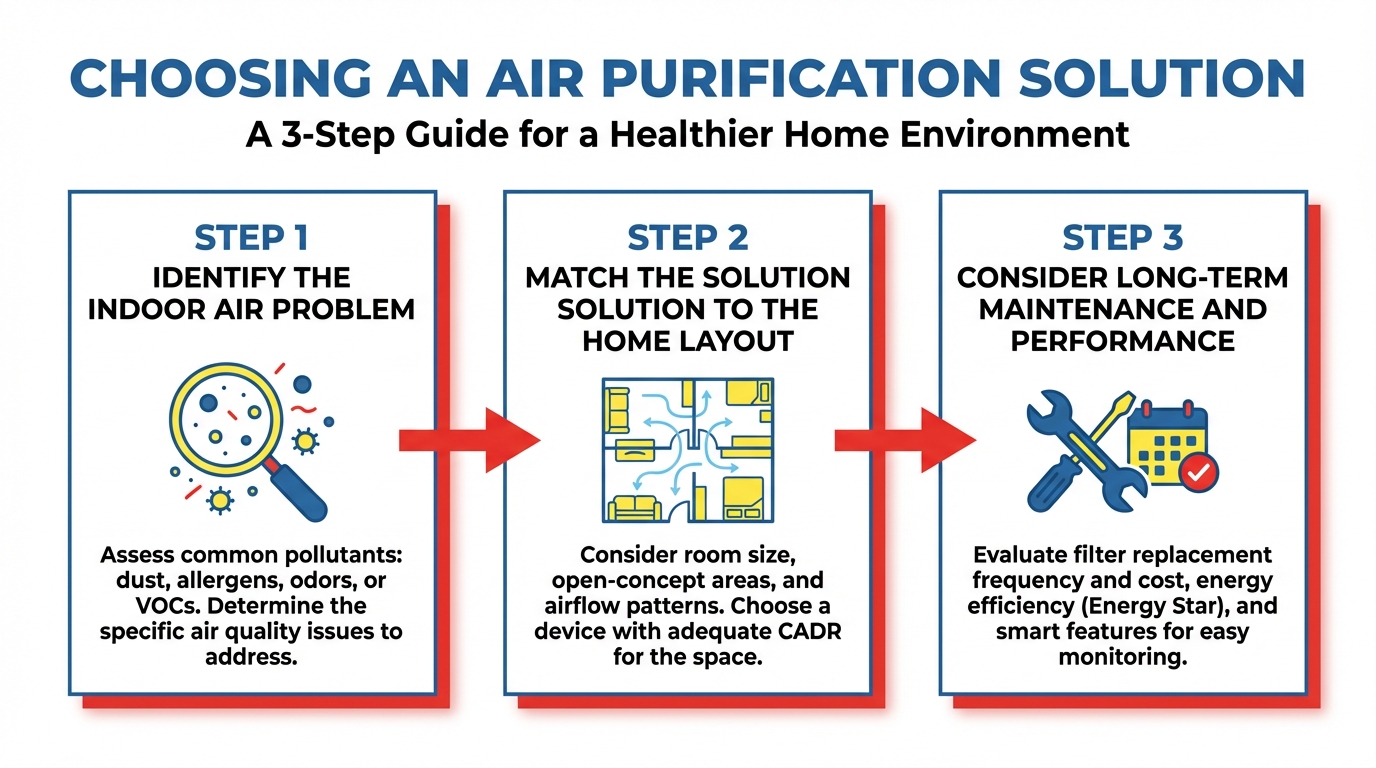
How Do You Choose the Right Home Air Purification Solution?
Choosing the right solution starts with identifying what problem you are actually trying to solve and then matching technology, sizing, and maintenance commitment to that specific need.
Step 1: Identify the Indoor Air Problem
Is your primary concern dust and particles, pet dander, seasonal allergens, odors, smoke, or biological contaminants like mold spores? Each issue points toward a different combination of filtration and purification technology. A home with three dogs and dusty return vents has different needs than a home near a busy highway dealing with fine particulate matter.
Step 2: Match the Solution to the Home Layout
Consider home size, number of HVAC zones, duct condition, and where family members spend the most time. A 2,200-square-foot home with a single central system is well suited for an integrated whole-home purifier. A home with a ductless mini-split in the master bedroom may need a portable unit for that room specifically. If your ducts need attention before a purification upgrade, services like air duct sealing can prevent untreated air from bypassing the purifier through leaks.
Step 3: Consider Long-Term Maintenance and Performance
Factor in ongoing costs for filter replacement, UV bulb changes if applicable, and professional inspections. A system that costs less upfront but requires expensive filters every three months may end up costing more over five years than a higher-quality system with annual maintenance needs. The EPA recommends that air cleaners be correctly sized and operated continuously for the best results.
Maximizing Your Home Air Purification Solutions
The best air purification system in the world underperforms if installed on a neglected HVAC system. Duct leaks allow unconditioned, unfiltered air to mix with treated air. Dirty evaporator coils and blower components reduce airflow, which means less air passes through the purification unit per cycle. Clogged return vents create pressure imbalances that pull in dust from attic spaces and wall cavities. Addressing these issues turns a good purification setup into a genuinely effective one.
Professional service from Nonstop Air Duct Cleaning Austin covers duct inspection, cleaning, and airflow assessment, giving homeowners a clear picture of what their system needs before investing in additional equipment. This practical, no-pressure approach helps ensure that every dollar spent on air purification delivers real, measurable improvement in indoor air quality. Homeowners with older systems may also want to explore air duct repair or air duct insulation to maximize the efficiency of their purification investment.
What Is the Next Step for Your Austin Home?
Are you noticing more dust than usual, dealing with lingering odors, or wondering whether your current HVAC filtration is actually doing enough for your family? The most practical next step is a professional evaluation of your duct system and airflow. Nonstop Air Duct Cleaning Austin provides thorough duct inspection, cleaning, and honest guidance on how to improve your indoor air quality based on what your home actually needs. Contact Nonstop Air Duct Cleaning Austin to request a free estimate and find out which home air purification solutions make the most sense for your home. We serve homeowners across Austin, Round Rock, Cedar Park, San Marcos, Georgetown, Pflugerville, Kyle, Leander, Bastrop, Buda, and surrounding communities in Travis, Williamson, and Hays counties.
Breathe easier at home. Schedule your air duct service in Austin today and start with a clean foundation for better indoor air.
What Our Customers Say
Find Us
Frequently Asked Questions
Home air purification solutions include any device or system designed to reduce airborne contaminants inside a home. This ranges from portable HEPA purifiers for a single room to whole-home systems integrated into the HVAC ductwork that treat air throughout the entire house.
For many homeowners, especially those with larger homes, allergy concerns, or pets, whole house air purifiers deliver consistent value by treating all the air that circulates through the HVAC system. The upfront cost is higher than a portable unit, but the coverage and convenience often justify the investment.
Yes. A system with HEPA-grade filtration can capture a significant portion of pet dander particles circulating in the air. For the best results, combine air purification with regular cleaning, grooming, and professional duct maintenance to prevent dander buildup inside the duct system.
Air purifiers equipped with both HEPA and activated-carbon filters can reduce smoke particles and some odors. However, results vary depending on the intensity and source of the smoke. Persistent chemical odors or heavy smoke exposure may require more specialized filtration or source removal.
Most HEPA filters in portable units need replacement every six to twelve months. Whole-home system filters vary based on the type and rating, but checking them every three months and replacing as needed is a reliable starting point. Homes with pets, smokers, or high dust levels may need more frequent changes.
In most cases, yes. Many whole-home purification units are designed to integrate directly into existing ductwork. A professional assessment of your HVAC system ensures compatibility, proper sizing, and correct installation so the purifier works efficiently without restricting airflow.
Air filtration uses physical media like HEPA or pleated filters to capture solid particles such as dust and pollen. Air purification encompasses filtration but also includes technologies like activated carbon and UV light that target gases, odors, volatile organic compounds, and biological contaminants. Many effective systems combine both approaches.
Yes, starting with clean ductwork is highly recommended. If your ducts contain years of accumulated dust and debris, a new purification system will spend its capacity fighting existing buildup rather than fresh contaminants. Professional duct cleaning creates a clean baseline that allows your purification investment to work more effectively from the start.
HEPA-equipped air purifiers can capture mold spores circulating in the air, which reduces the spores you breathe in. However, no air purifier solves a mold problem at its source. The root cause is always moisture, which must be addressed through proper remediation, humidity control, and ventilation before air purification can provide lasting relief.
Nonstop Air Duct Cleaning Austin serves homeowners across Austin, Round Rock, Cedar Park, San Marcos, Georgetown, Pflugerville, Kyle, Leander, Bastrop, Buda, and surrounding communities throughout Travis, Williamson, and Hays counties.
