Commercial Indoor Air Quality Solutions: How Austin Businesses Improve Air Quality, Ventilation, and HVAC Performance
Discover proven strategies Austin businesses use to eliminate indoor air pollutants, boost HVAC efficiency, and create healthier workplaces across Travis, Williamson, and Hays counties.
Is Your Commercial HVAC System Working Against You?
Employees complaining about stuffiness, dust, or headaches? Austin businesses lose thousands in productivity and energy costs from neglected air systems. Get a professional assessment before small problems become expensive ones.
Table of Contents
What Defines Good Indoor Air Quality in a Commercial Setting?
Good indoor air quality in a commercial building means the air contains low levels of pollutants, maintains balanced humidity, and includes an adequate supply of fresh outdoor air. According to OSHA’s indoor air quality guidance, acceptable IAQ exists when the majority of building occupants do not express dissatisfaction with the air and there are no known contaminant concentrations that pose a health risk.
In practice, this translates to a few measurable conditions. Carbon dioxide levels stay within a range that suggests proper ventilation. Relative humidity remains between roughly 30 and 60 percent. There are no persistent odors, visible mold, or excessive dust circulating through the space. The HVAC system delivers consistent airflow to every occupied zone without hot spots, cold spots, or stagnant pockets. When any of these benchmarks slip, occupants notice, even if they cannot pinpoint the exact cause.
For Austin businesses, foundational air quality starts with clean air delivery systems. Scheduling professional air duct cleaning removes accumulated debris from the pathways your HVAC uses to move conditioned air, giving every downstream improvement a cleaner starting point.
How Poor Workplace Air Quality Affects a Business
The consequences of poor indoor air quality extend well beyond comfort. The EPA notes that IAQ can affect occupant health, comfort, and overall building-related costs. When employees work in a space where the air feels heavy, dusty, or stale, productivity tends to decline. Complaints increase, and facility managers spend more time troubleshooting symptoms instead of preventing root causes.
Energy costs also rise. A clogged or dirty HVAC system works harder to push air through restricted pathways, consuming more electricity while delivering less cooling or heating. Over time, that strain shortens equipment lifespan and drives up repair frequency. For commercial property managers in Austin, where summer cooling loads are already significant, the financial impact compounds quickly.
Did You Know?
According to NIOSH investigations, inadequate ventilation is the single most common cause of indoor air quality complaints in commercial office buildings. For Austin businesses running HVAC systems nearly year-round, that ventilation performance gap quietly drives up energy bills, sick days, and employee turnover.
Mistakes Business Owners Make When Addressing Air Quality
One of the most common mistakes is treating symptoms rather than causes. Placing a portable air purifier in a lobby does not solve a building-wide ventilation deficiency. Replacing filters more frequently helps, but it cannot compensate for ductwork clogged with years of debris or coils coated in grime that restrict heat exchange.
Another frequent error is assuming that because the HVAC system still runs, it must be performing adequately. Commercial systems can operate at reduced efficiency for months or even years before a component fails outright. During that time, air quality degrades gradually. Occupants adjust to the conditions, and the problem only becomes visible when complaints spike or an inspection reveals contamination.
A third mistake involves ignoring humidity. Austin’s climate creates persistent moisture challenges, and many businesses underestimate how quickly excess humidity inside ductwork or air handling units can lead to microbial growth, musty odors, and degraded air quality.
Recognizing the Warning Signs Inside Your Building
Physical Symptoms Among Staff
Recurring headaches, fatigue, sinus irritation, and general discomfort among employees are classic indicators of indoor air quality issues. A NIOSH summary of office-building investigations found that inadequate ventilation was a leading cause of occupant complaints, alongside indoor contamination sources and outdoor pollutants entering the building. When multiple people in the same area report similar symptoms that improve after leaving the building, the HVAC system and ventilation setup deserve a closer look.
Environmental Red Flags
Visible dust accumulation on vent covers and registers, persistent musty or chemical odors near supply vents, and condensation on windows or surfaces all point to potential IAQ problems. The EPA’s office-building occupant guide explains that these environmental signs often indicate HVAC maintenance needs, poor filtration, or moisture issues that allow contaminants to circulate through occupied spaces. If filters are clogging faster than expected or certain zones consistently feel warmer and stuffier than others, the system is telling you something.
Commercial IAQ Warning Signs Checklist
- Multiple employees reporting headaches, fatigue, or sinus irritation in the same zone
- Visible dust buildup on vent covers and registers within days of cleaning
- Persistent musty or chemical odors near supply vents or air handlers
- Condensation forming on interior windows or cold surfaces
- HVAC filters clogging or darkening faster than the replacement schedule
- Noticeable temperature differences between zones served by the same system
- Symptoms that improve on weekends or after employees leave the building
Comparing Ventilation, Filtration, and Source Control
Business owners often ask whether improving ventilation or upgrading filtration matters more. The honest answer is that both play different roles, and the right emphasis depends on the specific building and its challenges. Source control, the practice of reducing pollutants at their origin, adds a third layer of defense.
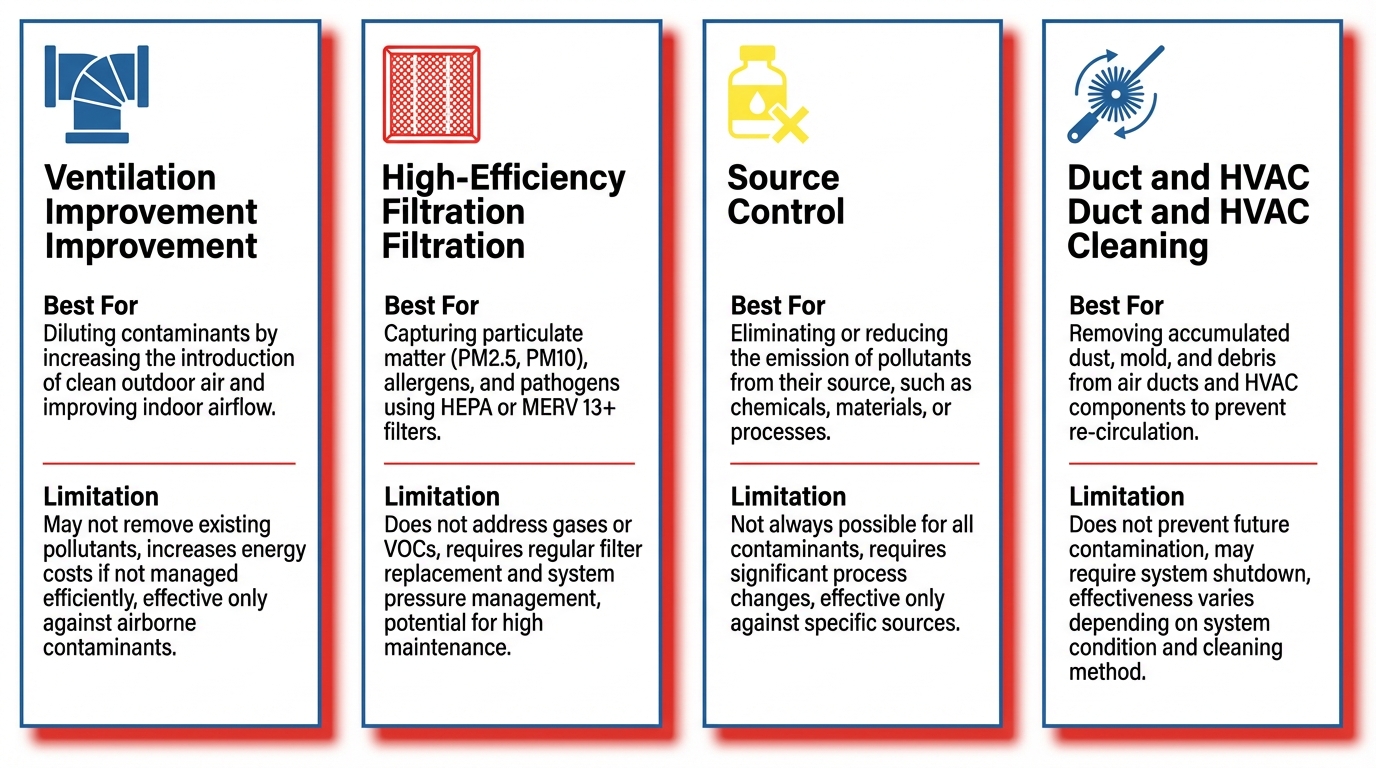
| Strategy | What It Does | Best For | Limitation |
|---|---|---|---|
| Ventilation improvement | Increases fresh outdoor air intake and reduces recirculated stale air | Stuffy spaces, high CO2, odor complaints | Raises energy costs if not balanced properly |
| High-efficiency filtration (MERV-13+) | Captures smaller airborne particles before they reach occupied zones | Dust-heavy environments, allergy-sensitive occupants | Requires HVAC compatibility check; may reduce airflow |
| Source control | Eliminates or reduces pollutants at their origin | Newly renovated spaces, chemical sensitivity complaints | Not always practical for every pollutant source |
| Duct and HVAC cleaning | Removes accumulated debris from ducts, coils, blowers, and air handlers | Systems with visible contamination, post-construction, deferred maintenance | Not a standalone fix if ventilation design is inadequate |
The most effective commercial indoor air quality solutions combine two or more of these strategies. Cleaning the system first ensures that upgraded filters and improved ventilation actually deliver clean air rather than pushing existing contaminants around more efficiently.
What Does a Professional Commercial HVAC Cleaning Actually Include?
Many business owners assume duct cleaning means running a vacuum through a few vents. In a professional commercial context, the scope is significantly broader. Industry standards referenced by NADCA outline that a thorough commercial HVAC cleaning project should assess and clean all contaminated components of the air distribution system.
That typically includes supply and return air ducts, registers, grilles, diffusers, heat exchange coils, condensate drain pans, fan motor and housing, the air handling unit housing, and any accessible internal insulation or lining. For larger facilities, this process may take several hours or span multiple visits depending on system size and contamination level.
Nonstop Air Duct Cleaning Austin provides commercial air duct cleaning services that address the full scope of these components. Using professional-grade equipment designed for high-capacity commercial systems, the team inspects each section, removes accumulated debris, and verifies improved airflow before the job is complete. This thorough, component-by-component approach is one of the practical advantages Austin businesses gain when working with a dedicated local provider rather than a general maintenance contractor.
Components of a Complete Commercial HVAC Cleaning
- Supply and return air ducts throughout all zones
- Registers, grilles, and diffusers
- Heat exchange coils (evaporator and condenser)
- Condensate drain pans and drainage lines
- Fan motor, blower assembly, and housing
- Air handling unit interior and accessible insulation
- Post-cleaning airflow verification and documentation
How Austin’s Climate Complicates Commercial Air Quality
Austin’s subtropical climate creates a specific set of challenges for indoor air quality. Summer humidity levels frequently push above 70 percent outdoors, and that moisture enters commercial buildings through ventilation intake, door traffic, and even through the building envelope. When the HVAC system’s dehumidification capacity falls short or condensate drain pans are not properly maintained, moisture accumulates inside the ductwork and air handling units.
That trapped moisture creates an environment where mold and microbial growth can take hold quickly. The EPA’s commercial mold remediation guide emphasizes that fixing the water or humidity problem must come before or alongside any cleaning effort, because cleaning alone will not prevent regrowth if the moisture source remains active. For Austin businesses, this means that IAQ management must always account for humidity control, not just filtration and airflow.
When moisture damage has already occurred inside commercial ductwork, expert mold remediation may be necessary alongside cleaning to restore the system to a safe, functional condition. Nonstop Air Duct Cleaning Austin understands these local climate pressures and factors humidity assessment into every commercial evaluation, which helps Austin businesses avoid recurring moisture-related air quality issues.
Protect Your Business and Your Employees
Over 500 Austin commercial properties have trusted Nonstop Air Duct Cleaning Austin to restore clean airflow and eliminate hidden contamination. Your building deserves the same professional attention.
A Practical Scenario: The Austin Office That Could Not Fix Its Dust Problem
Consider a mid-size Austin office that occupies two floors of a commercial building near the Arboretum. The property manager replaces HVAC filters on schedule and the cleaning crew dusts every week. Yet employees still report visible dust settling on desks within hours, and the supply vents have a faintly musty smell after the system cycles on each morning.
The issue is not the filter schedule. It is the accumulation of debris inside the ductwork, on the blower motor, and across the evaporator coils that the filters alone cannot address. Every time the system runs, it pushes air past those contaminated surfaces and carries fine particles into the workspace. The musty smell points to moisture that has collected in the drain pan or on the coil surface, feeding microbial activity.
In this scenario, the solution involves a full commercial HVAC cleaning, a drain pan inspection, coil treatment, and a review of the building’s humidity management strategy. Once those steps are complete, the filters can do their job effectively and the dust complaints resolve. This is a pattern Nonstop Air Duct Cleaning Austin encounters regularly across Austin commercial properties, from downtown office towers to Round Rock business parks.
How Often Should a Commercial HVAC System Be Cleaned?
There is no single universal answer because the right frequency depends on several factors specific to each building. The table below outlines general guidance based on common commercial environments in the Austin area.
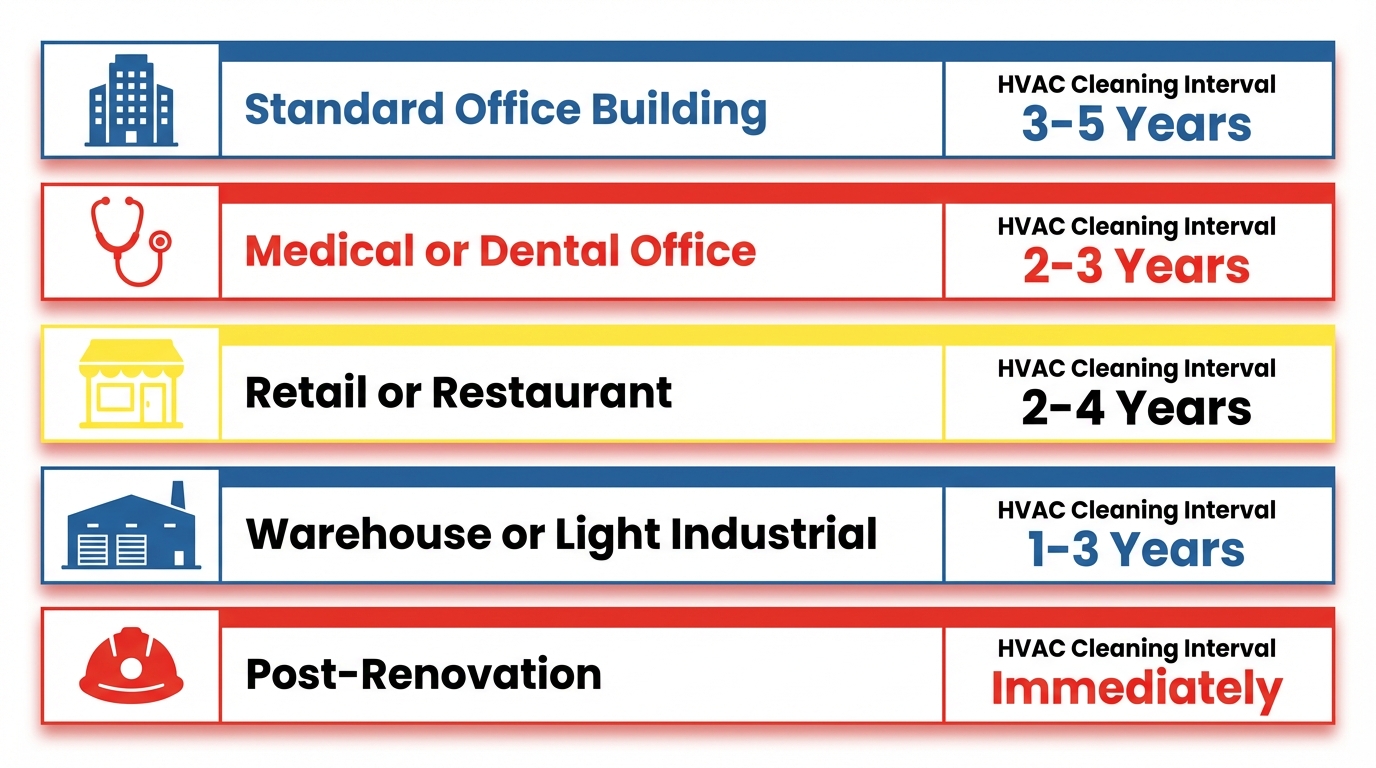
| Building Type | Typical Cleaning Interval | Key Factors |
|---|---|---|
| Standard office building | Every 3-5 years | Occupant count, filter maintenance history, age of ductwork |
| Medical or dental office | Every 2-3 years | Hygiene requirements, patient sensitivity, regulatory considerations |
| Retail or restaurant | Every 2-4 years | Cooking fumes, high foot traffic, product dust or fibers |
| Warehouse or light industrial | Every 1-3 years | Airborne particulates from operations, loading dock exposure |
| Post-renovation (any type) | Immediately after construction | Drywall dust, insulation fibers, construction debris |
The most reliable approach is to schedule periodic inspections rather than relying solely on a calendar. A professional assessment reveals actual conditions inside the ductwork and components, so cleaning is performed when it is genuinely needed rather than on an arbitrary cycle. Nonstop Air Duct Cleaning Austin offers this kind of condition-based evaluation, helping businesses spend their maintenance budget where it makes the most measurable difference.
What Should a Business Owner Ask Before Hiring an Air Quality Service?
Not every company that advertises air duct cleaning delivers a thorough commercial-grade service. Before signing a contract, Austin business owners should ask pointed questions that reveal whether a provider understands the scope of commercial work. Does the company clean all HVAC components or only accessible duct runs? What equipment is used, and is it rated for commercial system volumes? Will the provider perform an initial inspection and document findings before starting work? Is there a post-cleaning verification step to confirm improved airflow?
Asking about references from other commercial clients in Austin is also worthwhile. A provider experienced with office buildings, retail spaces, or multi-tenant properties will approach the work differently than one that primarily handles residential jobs. The complexity of commercial HVAC layouts, zoned systems, and higher airflow volumes demands equipment and expertise that not every service provider carries.
Advanced Office Air Quality Improvements Beyond Cleaning
Once the HVAC system is clean and functioning properly, additional improvements can further elevate indoor air quality. Upgrading to MERV-13 or higher-rated filters captures a significantly larger percentage of fine particles, including many common allergens and airborne irritants. This upgrade should only be made after confirming that the existing system can handle the increased air resistance without reducing airflow below design specifications.
Ventilation rates are another area worth evaluating. ASHRAE Standard 62.1 establishes minimum ventilation requirements for commercial and institutional buildings, specifying how much outdoor air must be introduced per occupant and per square foot of floor area. Many older Austin commercial buildings, particularly those in established corridors along MoPac, I-35, and Highway 183, were designed to earlier standards and may benefit from ventilation adjustments, especially in densely occupied zones like open-plan offices or training rooms.
Source control rounds out the strategy. Switching to low-VOC cleaning products, ensuring copiers and printers vent properly, and isolating renovation areas from occupied spaces all reduce the pollutant load that the HVAC system must handle. When combined with clean ducts, proper filtration, and adequate ventilation, these measures create a layered defense that produces noticeably cleaner indoor air.
The Financial Case for Proactive IAQ Maintenance
Investing in commercial indoor air quality solutions is not just an occupant comfort decision. It is a financial one. A cleaner HVAC system operates more efficiently because air moves through unobstructed pathways and across clean heat exchange surfaces. That efficiency translates directly to lower energy consumption, which matters considerably during Austin’s long, hot cooling season when commercial cooling costs can spike dramatically.
Equipment longevity also improves. Blower motors that do not have to fight against debris buildup last longer. Coils that transfer heat efficiently experience less strain. Fewer emergency repair calls mean lower maintenance costs and less disruption to business operations. Over a five-to-ten-year period, proactive maintenance typically costs less than reactive repairs triggered by system failures or occupant complaints that have reached a critical point.
Employee retention and satisfaction benefit as well. Workers who are comfortable and breathing cleaner air are less likely to cite workplace conditions as a reason for dissatisfaction. For businesses competing for talent in Austin’s active job market, the quality of the work environment is a factor that employees notice and remember.
Frequently Asked Questions
Can dirty HVAC coils and blowers affect office air quality?
Yes. Coils and blowers are two of the most commonly overlooked contamination points in a commercial HVAC system. When coils are coated with grime, they become less efficient at heat transfer and can harbor moisture that supports microbial growth. Dirty blower assemblies push contaminated air into every room the system serves. Cleaning these components is a core part of a thorough commercial HVAC service.
Is filtration or ventilation more important for workplace air quality?
Both serve different functions and work best together. Ventilation introduces fresh outdoor air and dilutes indoor pollutants, while filtration captures particles from recirculated air. A building with excellent filtration but poor ventilation can still have elevated CO2 and stale conditions. A building with strong ventilation but weak filtration may let outdoor particulates circulate freely indoors.
Do air quality upgrades help reduce odor and dust complaints?
In most cases, yes. Persistent odors often originate from contaminated HVAC components, trapped moisture, or recirculated air that has not been properly filtered. Dust complaints frequently trace back to dirty ductwork or filters that are not capturing fine particles effectively. Addressing these root causes through cleaning, filtration upgrades, and ventilation adjustments typically produces a noticeable reduction in both types of complaints.
Can humidity problems make office air quality worse?
Excess humidity inside ductwork or air handling units promotes mold growth, musty odors, and degraded air quality. In Austin’s climate, where outdoor humidity is high for much of the year, commercial HVAC systems must actively manage moisture through properly functioning condensate drainage, coil maintenance, and dehumidification capacity. Ignoring humidity is one of the fastest paths to serious IAQ problems.
What is the difference between residential and commercial air duct cleaning?
Commercial systems are larger, move significantly more air, and often include zoned configurations, multiple air handling units, and longer duct runs. The equipment required to clean commercial systems effectively is more powerful and specialized than residential tools. The inspection and documentation process is also more detailed because commercial buildings have more components and greater regulatory considerations.
How can I tell if my commercial ductwork needs cleaning versus replacement?
If ductwork is structurally sound but contaminated, professional cleaning is usually sufficient. If ducts show signs of physical damage such as collapsed sections, significant corrosion, deteriorating internal insulation, or persistent leaks that cannot be sealed effectively, replacement may be the more cost-effective long-term solution. A professional inspection can determine which approach makes sense for your specific system.
Contact Nonstop Air Duct Cleaning Austin
Ready to improve the air quality in your Austin business? Whether your employees are mentioning stuffiness, your vents are collecting dust faster than they should, or you want to know the true condition of your commercial HVAC system, the practical next step is a professional evaluation.