How Air Duct Cleaning Works: The Full Professional Process Explained
Your Austin home’s ductwork collects years of dust, pet dander, and debris behind the walls. This complete guide walks you through every stage of professional air duct cleaning — from inspection to final verification — so you know exactly what to expect.
Concerned About What is Hiding in Your Ducts?
Austin homeowners trust Nonstop Air Duct Cleaning Austin for honest assessments and thorough results. Over 500 homes serviced across Travis, Williamson, and Hays counties.
Limited availability this month — book your inspection now
Table of Contents
- What Exactly Is Air Duct Cleaning?
- How Does Air Duct Cleaning Actually Work?
- What Happens During a Professional Appointment?
- Tools and Equipment Used in Duct Cleaning
- Negative Pressure Duct Cleaning Explained
- Comparing Duct Cleaning Methods
- A Common Mistake Homeowners Make
- Do Professionals Clean the Entire HVAC System?
- Airflow, Energy, and System Integrity
- How Long Does the Process Take?
- Is Duct Cleaning Messy Inside Your Home?
- Can It Remove Mold, Odors, and Allergens?
- How to Know the Job Was Done Properly
- Is Air Duct Cleaning Actually Worth It?
- Can Homeowners Clean Ducts Themselves?
- Frequently Asked Questions
What Exactly Is Air Duct Cleaning?
Air duct cleaning is a comprehensive maintenance task designed to remove accumulated dust, debris, and potential microbial growth from your HVAC system’s air distribution network. A proper professional duct cleaning process goes well beyond wiping down the vent covers you can see. According to the U.S. Environmental Protection Agency, a thorough job should cover all components of the forced-air system — supply ducts, return ducts, registers, grilles, diffusers, and the air handling unit itself.
Nonstop Air Duct Cleaning Austin follows this multi-step, industry-standard approach when performing comprehensive air duct cleaning services for homes across the Austin area. The goal is to restore cleaner airflow through every line in the system, not just the parts that are easy to reach.
How Does Air Duct Cleaning Actually Work?
At its core, professional duct cleaning works by creating powerful suction inside the duct system, mechanically loosening debris from the interior walls, and collecting everything into a sealed vacuum unit. The contaminants travel toward the vacuum rather than scattering into your living space. This controlled approach is what distinguishes professional service from simply sticking a household vacuum into a vent opening.
Most professional teams begin with a system assessment, then set up equipment to establish negative pressure inside the ductwork, use specialized agitation tools to dislodge buildup, and finally verify that the lines are clean. The entire cycle is designed to handle years of accumulated particles in a single, methodical session.
What Happens During a Professional Duct Cleaning Appointment?
Many Austin homeowners wonder what to expect when a technician arrives. The typical sequence breaks into four core phases, each playing a critical role in a complete cleaning.
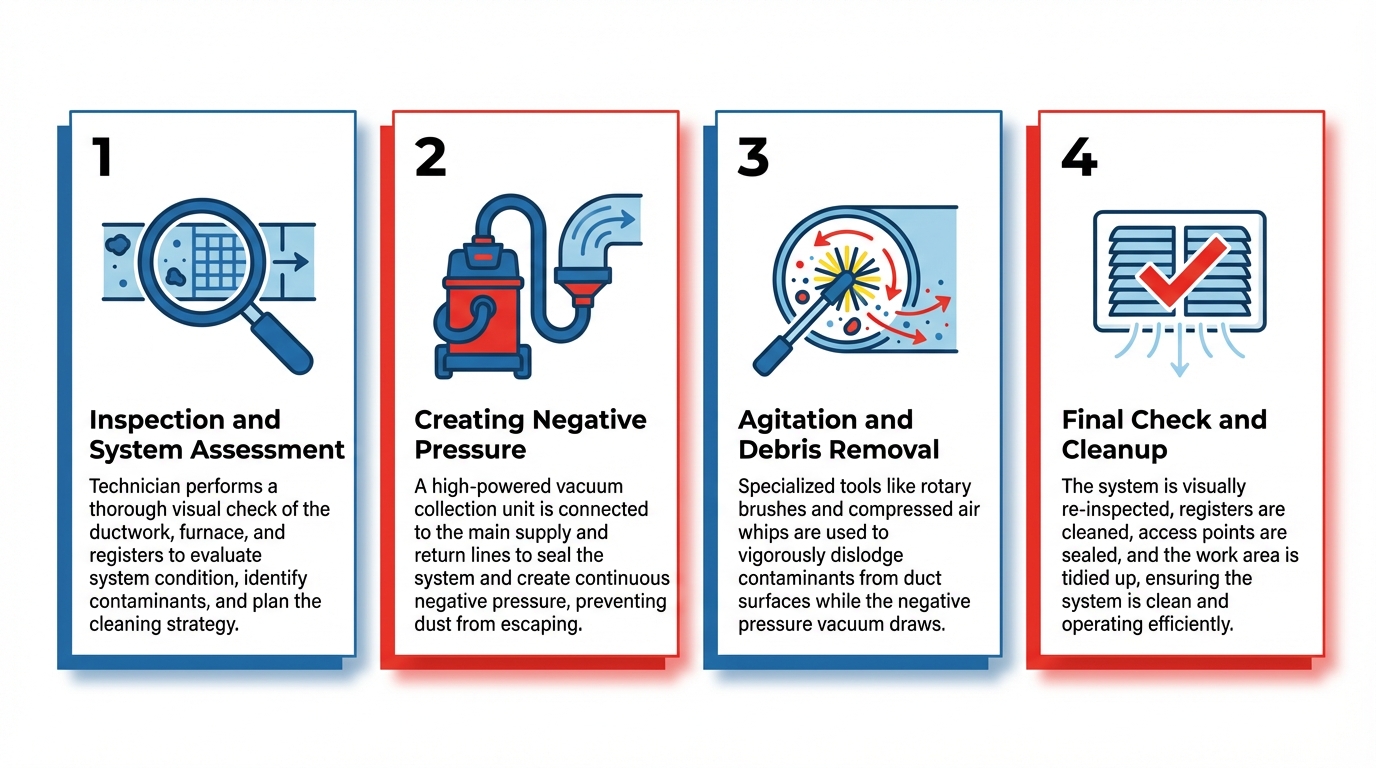
Inspection and System Assessment
Before any cleaning begins, the technician examines the HVAC system. This often involves checking the condition of visible ductwork, looking at registers for signs of heavy buildup, and sometimes using a small camera to inspect deeper sections. The inspection helps identify problem areas, the type of duct material in use, accessibility challenges, and any signs of moisture, pest activity, or biological growth that may require special attention.
Creating Negative Pressure
A high-powered vacuum — typically a truck-mounted or portable unit equipped with HEPA filtration — is connected to the main trunk line of the duct system. Once activated, it creates negative pressure throughout the network. This means air is being pulled toward the vacuum, so any debris that gets dislodged during the cleaning phase travels in one direction: into the collection unit, not into your home.
Agitation and Debris Removal
With the vacuum running, the technician works through each duct line using agitation tools to break loose dust, dirt, and debris clinging to the interior walls. Common tools include motorized rotary brushes, air whips, compressed-air nozzles, and devices sometimes called “skipper balls.” The specific tools chosen depend on the duct material, diameter, and severity of the buildup.
Final Check and Cleanup
After every supply and return line has been addressed, the technician performs a final check. Registers and grilles are reinstalled, access points are sealed, and the work area is cleaned up. Some professionals offer before-and-after photos so homeowners can see the difference inside the ducts. A responsible technician will also explain what was found and whether any additional service — such as duct sealing or sanitizing — may be worth considering.
A Scenario Most Austin Homeowners Recognize
Picture this: you moved into a home built in the early 2000s. The previous owners had pets, completed a garage conversion, and never once had the ducts cleaned. Within a few weeks of moving in, you notice a thin layer of dust reappearing on furniture within a day of cleaning. The air smells slightly stale when the system kicks on. Some rooms feel stuffy while others are fine. This is exactly the kind of situation where understanding the duct cleaning process helps you evaluate whether to schedule professional service rather than guessing.
Nonstop Air Duct Cleaning Austin regularly helps homeowners in this position. Because the team inspects the system before quoting any work, you get a clear picture of your duct condition before committing to anything.
What Tools and Equipment Are Used in Duct Cleaning?
The effectiveness of the cleaning depends heavily on the equipment involved. Below is a comparison of the primary tools used in professional duct cleaning and their specific roles in the process.
| Equipment | Function | Best Suited For |
|---|---|---|
| Truck-mounted or portable HEPA vacuum | Creates sustained negative pressure and collects all extracted debris | Whole-system cleaning on any duct type |
| Motorized rotary brushes | Scrub interior duct walls to dislodge caked-on dust | Rigid metal ductwork with heavy buildup |
| Air whips and skipper balls | Deliver bursts of compressed air to knock debris free | Long duct runs and hard-to-reach sections |
| Compressed-air nozzles | Direct high-velocity air at specific deposits | Register boots, junctions, and tight bends |
| Inspection cameras | Provide visual assessment before and after cleaning | Verifying results and identifying hidden issues |
Nonstop Air Duct Cleaning Austin utilizes industrial-grade HEPA-filtered vacuums and pneumatic agitation tools as part of their standard service package. This combination ensures that the debris extracted from your system is captured rather than redistributed.
What Is Negative Pressure Duct Cleaning and Why Does It Matter?
Negative pressure is arguably the most important concept in professional duct cleaning. When the vacuum is connected and running, it creates a controlled suction environment inside the entire duct network. Every particle that gets knocked loose by brushes or compressed air is pulled toward the collection point instead of floating into your rooms.
Without this step, agitating debris inside the ducts would actually make things worse — sending dust and allergens directly into your living space through the open vents. This is why professionals seal off registers they are not actively cleaning, maintaining the pressure differential throughout the session. It is also one of the clearest differences between a legitimate cleaning and a quick pass with a shop vacuum.
Did You Know?
According to the U.S. Department of Energy, duct systems with leaks and airflow restrictions can lose 20-30% of conditioned air before it ever reaches your living spaces. Professional cleaning that restores unobstructed airflow can directly reduce energy waste and lower utility bills, especially in Austin’s extreme summer heat when HVAC systems run nearly nonstop.
Comparing Duct Cleaning Methods: Which Approach Fits Your System?
There is no single duct cleaning method that works perfectly for every home. The best approach depends on your duct material, the level of contamination, and the layout of your system.
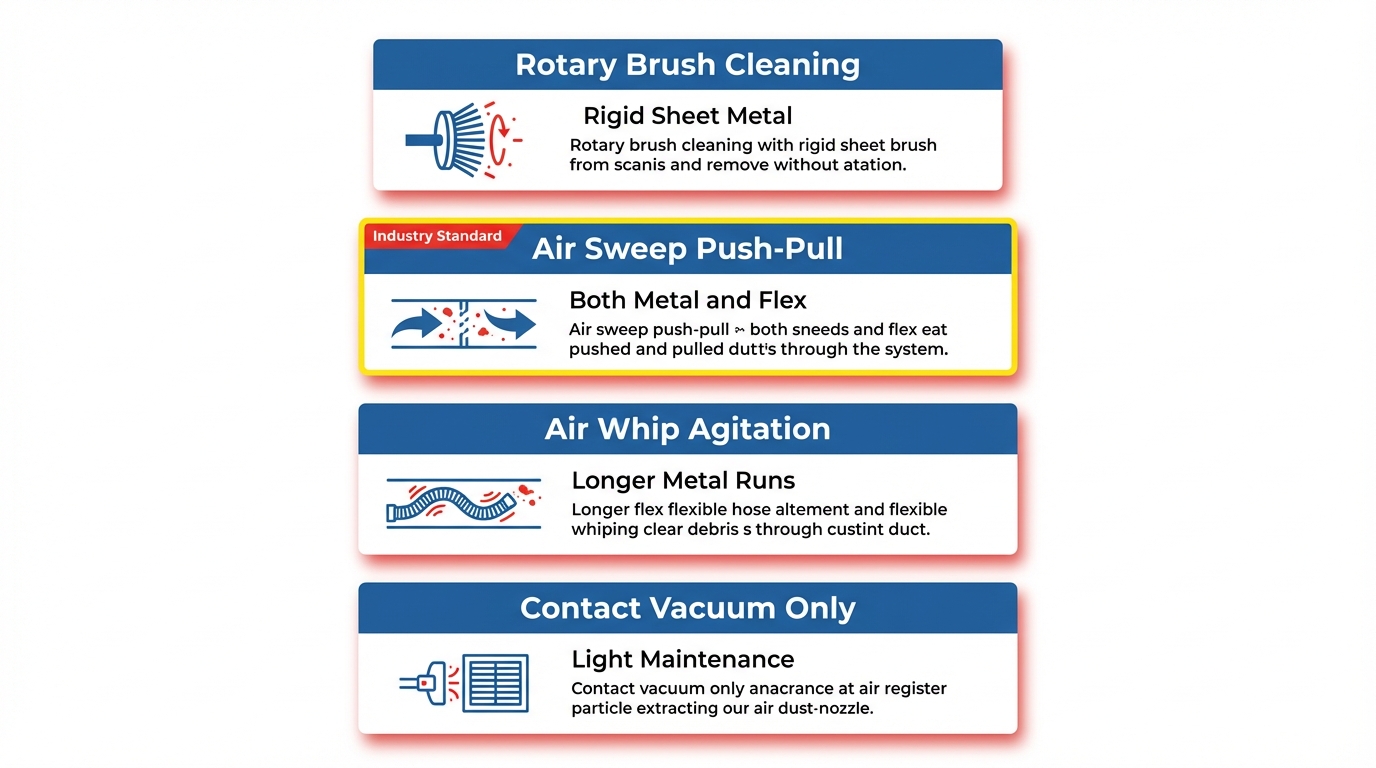
| Method | How It Works | Ideal Duct Type | Key Consideration |
|---|---|---|---|
| Rotary brush cleaning | Motorized brush spins inside the duct to scrub walls | Rigid sheet metal | Effective on heavy buildup; too aggressive for flex duct |
| Air sweep (push-pull) | Compressed air pushes debris toward the vacuum suction point | Both metal and flex | Industry gold standard for thorough extraction |
| Air whip agitation | Flexible hose with nozzle whips inside the duct, dislodging particles | Longer metal runs | Good for reaching deep into extended duct lines |
| Contact vacuum only | Vacuum placed at register opening without internal agitation | Light maintenance | Minimal effectiveness on embedded debris |
The push-pull method, which combines compressed air injection at one end with powerful vacuum extraction at the other, is widely considered the most thorough technique in the industry. It is referenced in the NADCA ACR standard as a recognized approach for assessment, cleaning, and restoration of HVAC systems.
Flex Duct vs. Metal Duct: Why It Changes the Approach
Austin homes use a mix of rigid metal and flexible ductwork. Flexible ducts, made from a wire coil wrapped in plastic or mylar, can be damaged by aggressive brushing. A trained technician adjusts the tool selection and pressure to match the duct type, protecting the system while still removing contaminants effectively. If your home has older flex duct that is already deteriorating, the inspection phase may reveal that repair or replacement is a better investment than cleaning alone.
A Common Mistake: Assuming All Duct Cleaning Services Are the Same
One of the most frequent errors homeowners make is choosing a duct cleaning provider based solely on price without understanding what the service includes. A company offering a whole-house cleaning for an unusually low price may only vacuum the register openings without ever entering the main trunk lines. This leaves the majority of the debris exactly where it was.
A thorough service should include cleaning of supply lines, return lines, the main trunk, register boots, and at minimum a visual check of the air handler compartment. When Nonstop Air Duct Cleaning Austin performs a job, the scope of work is explained before the crew begins, so there is no confusion about what is being cleaned and why.
What a Complete Duct Cleaning Should Include
- All supply duct lines cleaned individually
- All return duct lines cleaned individually
- Main trunk line thoroughly addressed
- Register boots vacuumed and inspected
- Visual check of the air handler compartment
- Before-and-after documentation or photos
- Clear explanation of findings and recommendations
Get an Honest Assessment of Your Duct System
Nonstop Air Duct Cleaning Austin shows you the condition of your ducts before recommending any service. No pressure, no hidden fees — just professional, transparent service backed by years of experience across Central Texas.
Austin’s peak allergy season puts extra strain on your HVAC — act before buildup gets worse
Do Professionals Clean the Entire HVAC System or Just the Vents?
This is one of the most important questions Austin homeowners ask — and the answer varies depending on the company. A reputable service should clean more than just the visible vent covers. At a minimum, the service typically addresses supply ducts, return ducts, and the register boots where they connect to the main lines.
Additional components like the blower compartment, evaporator coil housing, return drop, and plenum box may or may not be included as part of a standard cleaning. Some of these elements require separate service or specialized access. The key is transparency: a trustworthy provider will tell you exactly which components are included before work starts, and whether anything else needs attention based on the inspection findings.
Why Airflow and System Integrity Go Beyond Dust Removal
Cleaning the ducts is not just about removing visible dust. When debris accumulates inside the system, it restricts the volume of air that can flow freely through the network. Your blower motor has to work harder to push conditioned air through partially blocked lines, which can increase energy consumption and put unnecessary strain on the equipment.
According to the U.S. Department of Energy, duct systems that leak or have airflow restrictions can account for significant energy losses in a home. During a professional cleaning, technicians often identify leaks, disconnected joints, or damaged sections that may be contributing to uneven temperatures or wasted energy. Pairing clean ductwork with proper sealing and optimizing attic insulation creates a more efficient system overall.
How Long Does the Duct Cleaning Process Take?
For most Austin homes, a thorough duct cleaning takes between two and five hours. The actual duration depends on several factors: the square footage of the home, the number of supply and return vents, the number of HVAC units, the condition of the ductwork, and how accessible the system is.
A small single-story home with one system and moderate dust may take closer to two hours. A larger home with multiple zones, heavy pet dander accumulation, or post-renovation debris could take four hours or more. Be cautious of any provider that promises to clean your entire system in under an hour — it usually means corners are being cut. A time investment of two to five hours reflects a methodical approach where each line receives individual attention.
Is Air Duct Cleaning Messy Inside Your Home?
When the work is performed correctly, duct cleaning should not leave your home in disarray. The entire point of the negative-pressure setup and HEPA-filtered collection is to capture debris inside a sealed system rather than releasing it into your rooms. Professional crews typically lay down protective coverings around work areas, handle register removal carefully, and clean up after themselves before leaving.
You should expect some noise from the vacuum equipment and compressed-air tools, and there will be movement of equipment through your home. But visible dust clouds, dirty floors, or debris on furniture after the job is finished would be a red flag, not a normal outcome. Nonstop Air Duct Cleaning Austin takes care to protect your flooring and furnishings throughout the process, leaving the work area clean when the job is done.
Can Duct Cleaning Remove Mold, Odors, and Allergens?
This is where honest expectations matter most. Professional duct cleaning can remove accumulated dust, pet dander, pollen, and debris from the interior surfaces of your ducts. It can also reduce certain musty odors caused by organic material sitting inside the system. That said, duct cleaning alone does not solve every indoor air quality issue.
If there is active mold growth inside your ducts due to an ongoing moisture problem — a leaking roof, a condensation issue, or poor drainage near the air handler — cleaning the surfaces without addressing the moisture source means the problem will likely return. As the HUD Healthy Homes guidelines emphasize, keeping a home dry and maintaining humidity between 30 and 50 percent is essential for preventing mold. A thorough cleaning can be a valuable part of the solution, but identifying and fixing the moisture source comes first.
How Do You Know the Job Was Done Properly?
After spending money on a service you cannot easily see, it is natural to wonder whether the work was actually thorough. These practical indicators separate a quality job from a surface-level effort.
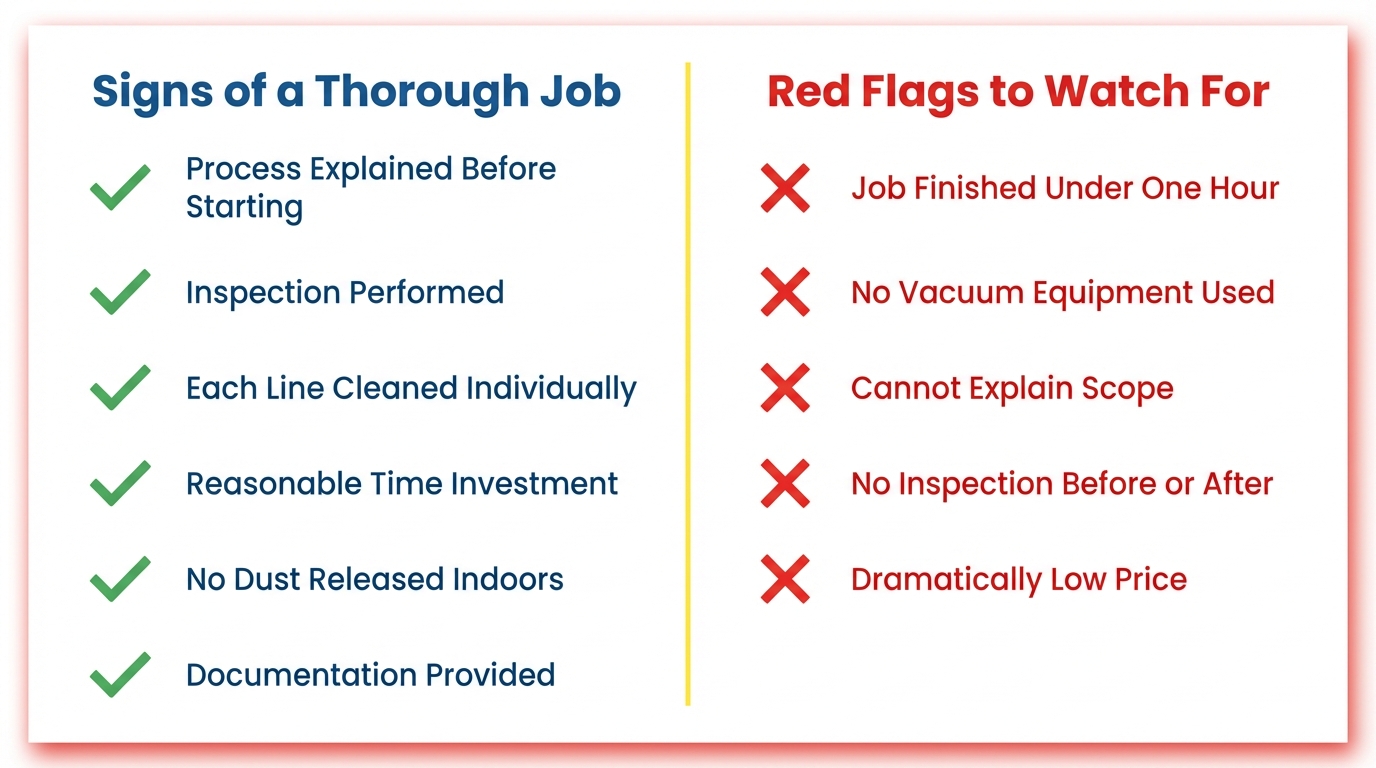
Signs of a Thorough Job
- The technician explained the entire process before starting
- A detailed inspection was performed to assess conditions first
- Each supply and return line was cleaned individually
- The work took a reasonable amount of time relative to home size
- No dust was visibly released into your living space
- Documentation or before-and-after photos were provided
- Clear explanation of findings and any recommendations offered
Red Flags to Watch For
The entire job was finished in under an hour for a full-size home. No vacuum or negative-pressure equipment was used. The provider could not explain which components were cleaned. There was no inspection before or after the work. Prices were dramatically lower than other local quotes without any clear explanation of what was included.
Is Air Duct Cleaning Actually Worth It?
Whether duct cleaning is worth the investment depends on your specific situation rather than a blanket yes or no. There are clear scenarios where the service provides meaningful value: you have just moved into a home with unknown maintenance history, your home recently underwent construction or renovation, you notice visible dust blowing from registers, your household includes allergy sufferers or pets, or your system has not been cleaned in many years and shows signs of heavy buildup.
On the other hand, if your ducts were cleaned recently, your home has good filtration, and you do not notice any airflow or air quality issues, you may not need the service right now. A responsible provider will tell you that. Nonstop Air Duct Cleaning Austin starts with an honest inspection so you can see the condition of your system and make an informed decision rather than relying on pressure tactics.
Can Homeowners Clean Air Ducts Themselves?
You can maintain your vent covers and the first few inches of visible ductwork with a household vacuum, and you should change your air filters regularly. Reaching deep into the duct lines, creating negative pressure, and using professional-grade agitation tools requires equipment and training that most homeowners simply do not have access to.
Attempting to clean ducts with consumer tools risks damaging flexible ductwork, loosening debris without capturing it, or disconnecting duct joints in hard-to-reach areas like attics or crawl spaces. For a full system cleaning, professional service is the practical and safer choice. The EPA recommends hiring a qualified contractor who can demonstrate proper equipment use and follows recognized industry procedures.
Frequently Asked Questions About the Duct Cleaning Process
How often should air ducts be cleaned?
There is no universal schedule, but many professionals recommend every three to five years for most homes. If you have pets, recent renovations, or notice signs of heavy buildup, more frequent cleaning may be appropriate. The best approach is to have the system inspected and base the timing on actual conditions rather than an arbitrary calendar date.
Does duct cleaning help with allergies?
Removing accumulated dust, pollen, pet dander, and other particles from the duct system can reduce the volume of airborne irritants circulating through your home. While duct cleaning is not a medical treatment, many homeowners with allergy sensitivities report noticeable improvement in comfort after a thorough cleaning, especially when combined with proper filtration and humidity control.
Will duct cleaning lower my energy bills?
If your ducts have significant debris restricting airflow, cleaning them can help your HVAC system operate more efficiently. The blower does not have to work as hard when air moves freely through clean lines. The energy savings depend on how restricted the system was before cleaning, so results vary from home to home.
Do I need to leave the house during duct cleaning?
You do not need to leave, but you should expect some noise from the vacuum and agitation equipment. Most homeowners stay home during the service without any issues. If anyone in the household has severe respiratory sensitivity, staying in a different area of the home or stepping out briefly during the active cleaning phase is a reasonable precaution.
What is the difference between duct cleaning and HVAC cleaning?
Duct cleaning focuses on the air distribution network — the supply and return lines that carry conditioned air throughout the home. HVAC cleaning can refer to a broader scope that includes the air handler, blower motor, evaporator coil, and other mechanical components. Some providers include certain HVAC components in their duct cleaning service, while others treat them as separate services. Always ask what is included before scheduling.
How do I choose the right duct cleaning company in Austin?
Look for a provider that performs a pre-cleaning inspection, uses HEPA-filtered vacuum equipment, explains the scope of work before starting, and takes a reasonable amount of time relative to the size of your home. Avoid companies that quote unusually low prices without explaining what is included or that promise to clean your entire system in under an hour. Ask about their process, equipment, and whether they provide before-and-after documentation.
Ready to See What Is Inside Your Ducts?
If your Austin home has not had a duct cleaning in several years — or ever — the first step is simply finding out what condition the system is in. Nonstop Air Duct Cleaning Austin provides honest assessments, explains the process clearly, and uses professional-grade equipment to deliver thorough results.
Contact Nonstop Air Duct Cleaning Austin
Whether you are dealing with visible dust at the registers, uneven airflow, lingering odors, or just want peace of mind after moving into a new home, our team is ready to help. We serve homeowners throughout Austin, Round Rock, Cedar Park, Pflugerville, and surrounding communities.